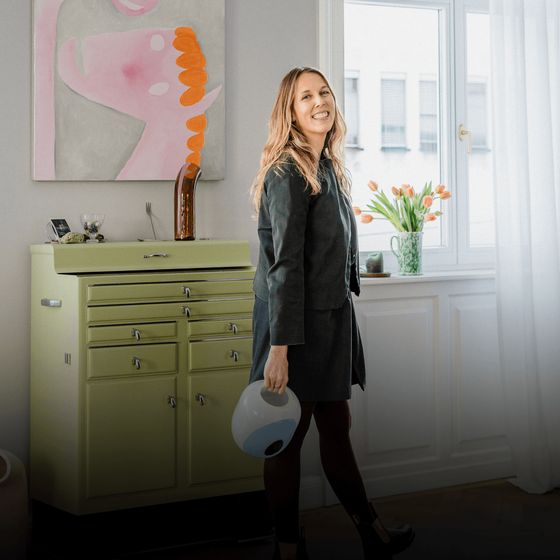
Kathrin Schaden was already working with glass as a student, and her final thesis dealt with windows and with digital and analogue space. In 2021 she founded Ursula Futura, a brand of handmade glass objects in the premium segment, made together with glassblowers in the Czech Republic. Her objects are sold in Austria and internationally. In conversation with Alena Gröfler, she explains why her brand deliberately doesn't bear her name, how she learned to hand things over and what matters to her at home.
HOMEISSUE You call your brand Ursula Futura your alter ego. How often are you addressed as Ursula?
Kathrin Schaden It actually happens to me very often. People also call me quite often and say: "Hi Ursula!" Usually I do tell them that I'm not actually Ursula, I'm Kathrin. But often I just leave it, because Ursula is, in a way, part of me too.
And why Ursula Futura?
It was very important to me that my brand wasn't named after me. And then I wanted it to be a person nonetheless, one who would also help me. When you start a business, you have a lot of fears, especially in design, where you expose yourself. Often you are your own harshest critic, your own worst enemy. So I had the idea of creating an alter ego who represents my bravest self, or really everyone's bravest self. It's meant to stand for the bravest self in each of us.
Since then, Kathrin Schaden keeps asking herself one question: "What would Ursula do?" Should she launch something already, should she dare, should she go somewhere where she has to give a speech, or to an exhibition opening? She loves doing things outside her comfort zone, and Ursula is a tool that helps her "say yes rather than no". The inspiration for the name was Ursula, the sea witch from The Little Mermaid. She is an octopus, and to Kathrin Schaden octopuses are mystical creatures that are forever transforming, trying new things and reaching out with their arms in different directions. Because her first collection was also inspired by water, the name fitted. But Ursula is a rather old-school name, she says, so she brought it into the future: Ursula Futura.
FROM LIQUID TO SOLID
Why did you choose glass and not another material?
Glass already fascinated me during my studies. I often did projects about optical phenomena, and my final thesis dealt with windows and with digital and analogue space. Glass was a material I worked with a lot, because you can do so much with incoming light, transparent, opaque, there's this interplay. My first collection was very much inspired by water, and it was clear that I wanted to do it in glass. Through the process in which it passes from liquid into a hardened state, glass is very similar to water, and in the way it refracts light you can also come very close to water.
There is no fixed route by which a product comes into being. Kathrin Schaden travels to the Czech Republic, shows the glassblowers what she has in mind, and then they spend several hours trying to get it right together. The piece then cools in the kiln, is cold-worked and cut, and sent to her. "It's usually just the case that it isn't perfect the first time."
She deliberately started slowly, with two products rather than ten straight away. She set herself deadlines, such as taking part in Blickfang, so that she would get out there, gather feedback and learn along the way. "I didn't want to wait a year and a half until I had ten products or so."
LEARNING TO LET GO
Kathrin Schaden has had one employee for just over a year, and she has outsourced a lot step by step, from logistics, now handled by a fulfilment centre, to digital ads and PR, for which she works with an agency again and again.
Do you find it hard to hand things over?
I think it depends. Handing over logistics was extremely easy for me, because I never enjoyed picking out the bowl, packing it and going to the post office. My passion simply wasn't in it. It was harder for me to hand over things like PR and marketing. But the longer I've been an entrepreneur, the easier it gets, because I realise that my resources are limited and that new input comes in. In the end, I can still decide what I want to do and what I don't.
What milestones since you founded the brand do you like to look back on?
One milestone was holding the first product in my hands and knowing: okay, this can be produced in series. Then came the first purchases from strangers on Shopify. That's an incredibly good feeling. Then of course Vöslauer was a milestone, and the first retail stores in Austria, but also internationally.
In the collaboration with Vöslauer, the challenge was to reshape the brand's bottles and turn them into one-off carafes, which at first wasn't easy for the glassmakers either. "And that's also what's cool about it, because you keep learning something new."
The route to international stores began with a hunch. Kathrin Schaden ran a 30-euro Instagram ad in New York, because she thought it might be a good market for her. A shop there, a trend-setting store, saw the ad, she believes, and wrote to her, and after that stores from other countries took notice in turn. "You never know what it might set in motion." Other things she could never have planned. Many people who do staging for major brands during Milan Design Week approached her, and today her objects are with a gallery in Milan that rents them out to such brands at those times. "I could never have thought of that."
Is a flagship store of your own something you're thinking about?
That would of course be incredible, I'd really like to have one. But I don't think it would be the first step in the near future. I'd like to expand the Ursula Futura universe a little more and offer other products as well, lamps as a first step. My dream would be to go bigger one day, into furniture. But I'm someone who loves her freedom enormously and often doesn't want to tie herself to one place. That's why I want to do it only once my team and the brand are big enough.
Her advice to anyone who wants to found a brand is simply to do it. You should get out there, make a website, not wait too long and gather feedback. A financial plan is also important, one you keep checking, and you mustn't lie to yourself about it. When you set something in motion, things start rolling, and a rough idea gets refined anyway. "The first step is really difficult," she says. After that, you're out there.
HOME
You help shape your clients' living spaces. What does home mean to you personally?
Living, for me, means feeling good. It's very important to me that you feel good and can express yourself there, so self-expression too. And for me home is simply a place of connection as well. Connection with others, whether with family, a partner or friends, matters a lot to me. Just as important is the connection with yourself, having places to retreat to where you can connect with yourself. Those are my three words, more or less. It has always been the case that I need to feel extremely at ease in my home.
When she and her husband furnished their apartment two years ago, design came first for her. "Design is just really important to me. He wanted to make some things more practical." That doesn't mean she is impractical, she says. Ideally, both go together: practical, beautiful and a place to feel good.
For her, work and private life can't be entirely separated. She tries not to work all the time in the evenings, but as an entrepreneur, ideas keep coming to you. She counts it as luck that her husband is an entrepreneur too, because he understands her thoughts, fears and joys. "It really is a rollercoaster. You feel every emotion."
The full conversation with Kathrin Schaden is available on the HOMEISSUE Podcast with Alena Gröfler.