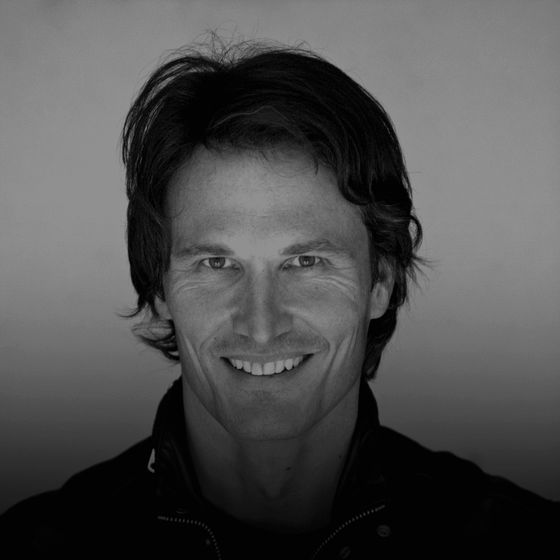
Thomas Mick was born in Carinthia. He studied design and also commerce at the University of Applied Arts in Vienna, spent time at the Royal College in London during his studies and afterwards took a master's degree in the United States. Back in Vienna he started out as a freelancer, worked for L'Oréal and Armani, and joined LVMH fourteen years ago. His core area there is Dior and Dior Beauty, and his team in Paris numbers 38 to 40 people. In conversation with Alena Gröfler and Caro Gorton, he explains why he prefers to take the glamour out of it, how a new look comes about at Dior and where he finds his inspiration.
The conversation opens with three quick questions. Vienna or Paris? "Paris." Clean, reduced forms in the style of Adolf Loos, or futuristic curves in the style of Frank Gehry? "I'd say more inspired by Adolf Loos." Birkenstocks or loafers? "I'd say loafers."
HOMEISSUE You have a highly coveted job that would be a dream for many people. How did you come to be Design Director at LVMH?
Thomas Mick I'd like to take a bit of the emotion out of it. Of course it always sounds very glamorous, but it's a job like any other. It's about design, and it's about delivering ideas. LVMH is a large group made up of more than 80 brands, and I don't handle all the design for LVMH; that would be absolutely impossible. My core area is Dior, Dior Beauty, but also culture from time to time, and more recently hospitality as well.
TWO HUNDRED APPLICATIONS
When Thomas Mick explains where his urge to realise ideas comes from, he goes back to his childhood. The children weren't showered with toys, there was little or no television, they spent a great deal of time outdoors and always had to come up with ways to keep themselves busy. He chose architecture and design, which for him are not opposites. It is "simply a question of the level of detail and of scale".
Back in Vienna, he was "brought down to earth a bit, like probably many people who have just finished something". "I even counted them once," he says of his job applications. There were more than 200, and he received many rejections. "Then I thought, apparently this isn't wanted, so I'll just have to do something myself." He set up an office in a very small one-room flat and went door to door as a freelancer.
His first commission was a product design for a cosmetics brand that became a success in Germany. L'Oréal's management saw the products during a market visit, and a call followed from L'Oréal Austria and Germany. On top of that, his studio won the competition to redesign the Römerquelle glass bottle. A few years later he was invited to Paris to present his proposals there, and found a place at Armani, the cosmetics line run by L'Oréal. For around four years his life played out between Vienna, Paris and Milan. People at LVMH saw this work and asked whether he could imagine working at Dior on the relaunch of the retail design for its cosmetics. That was fourteen years ago.
He sums up what he learned from it soberly. As a designer or architect, you absolutely need the opportunity to realise projects that are visible. The rest is openness, learning languages and flexibility. "They're all buzzwords that sound very nice, and it all has its price."
NO BLANK SHEET OF PAPER
What does a typical working day look like for you? Do you even have such a thing as a typical working day?
Yes, there is routine, and there is a lot of organisation, a fixed structure, a backbone around which you organise the projects. But it isn't a nine-to-five job. You are constantly dealing with input, and there is always something to do. It is also a management role. I don't sit down at 9 a.m. on a Monday in front of a sheet of paper and think something up; it starts with briefings.
In his view, creative work for a brand like Dior is sometimes even a little easier than other projects, because the brand's character is relatively clearly defined. Historical forms and design codes flow into a new look, and the team keeps modernising them. Every two weeks there is a Retail Design Committee, which is also a matter for the CEO. Out of several such review loops, something new emerges. His working day, he says, is "extremely multifaceted".
PLACES TO EXPERIENCE
Physical retail is struggling with online business, while the flagship stores of luxury brands are becoming ever more impressive. How do you see the future?
Of course, online retail has grown enormously in recent years, in the luxury sector too. I believe we are still in a transitional phase and that the two will establish themselves side by side. Nevertheless, speaking as a customer, I still see the need to create physical places for brands, spaces that can be experienced and where you experience the core of the brand. Luxury is precisely about creating desirability, and that doesn't only manifest itself through the product. You also buy a luxury product because you are buying a piece of the brand's history and its atmosphere. And that simply works better in a beautifully designed setting.
What will change is the way these places look, and Thomas Mick sees this as "the exciting design and architecture task". Fewer products will be presented, and the shops should be understood more as a platform that is programmed, with events, art, talks, encounters and service.
At Dior, the spa business grew out of the beauty business. Hospitality, too, is part of the experience that online retail cannot provide, for example the Dior Café in Saint-Tropez. In this way a boutique becomes a landmark, "a destination, as we'd say these days", with a bookshop, a café or a small museum.
IT'S SIMPLY WORK
How do you find inspiration for your projects?
For me, one approach is research. I really do a great deal of research and look at what others are doing, what is happening in art, what is happening in fashion and what Dior has done in the past. The other point is to go through the world with open eyes and to travel. I see it more as the movement from place to place.
Then there are the discussions in his creative environment and, in his case, simply the number of projects. "The more projects you have, the more inspiration. It's simply work." At the end of the day, design is a craft, and every project provides inspiration for a new one.
Which project stands out for you?
Normally people say the latest one is always the best. But one project that lies far in the past is, for example, the new design of the Römerquelle bottle. That was 20 years ago now, and it is a very important project for me. Another very beautiful project is a flagship store in Tokyo, in Ginza, which four or five years on I still find extremely creative and good. And the most recent is the new look for Dior Beauty, which we are rolling out over the course of this year.
HOME
His own home is not discussed in this conversation. What Thomas Mick describes are the places where he has lived and worked. There is the childhood with few toys and hardly any television, when the children spent a great deal of time outdoors. There is the very small one-room flat in Vienna that he set up as an office after all the rejections. And there are the roughly four years with Armani, when his life played out between Vienna, Paris and Milan. He already had one foot in Paris at the time, with a small apartment there.
He speaks about the life this profession brings without romanticising it. "Little private life, a lot of change, constantly," is how he sums it up. You could also call it little stability, but that is not how he would see it. The rest is a question of what you want to engage with. And to the very first question of the conversation, Vienna or Paris, his answer was: "Paris."
The full conversation with Thomas Mick is available on the HOMEISSUE Podcast with Alena Gröfler and Caro Gorton.