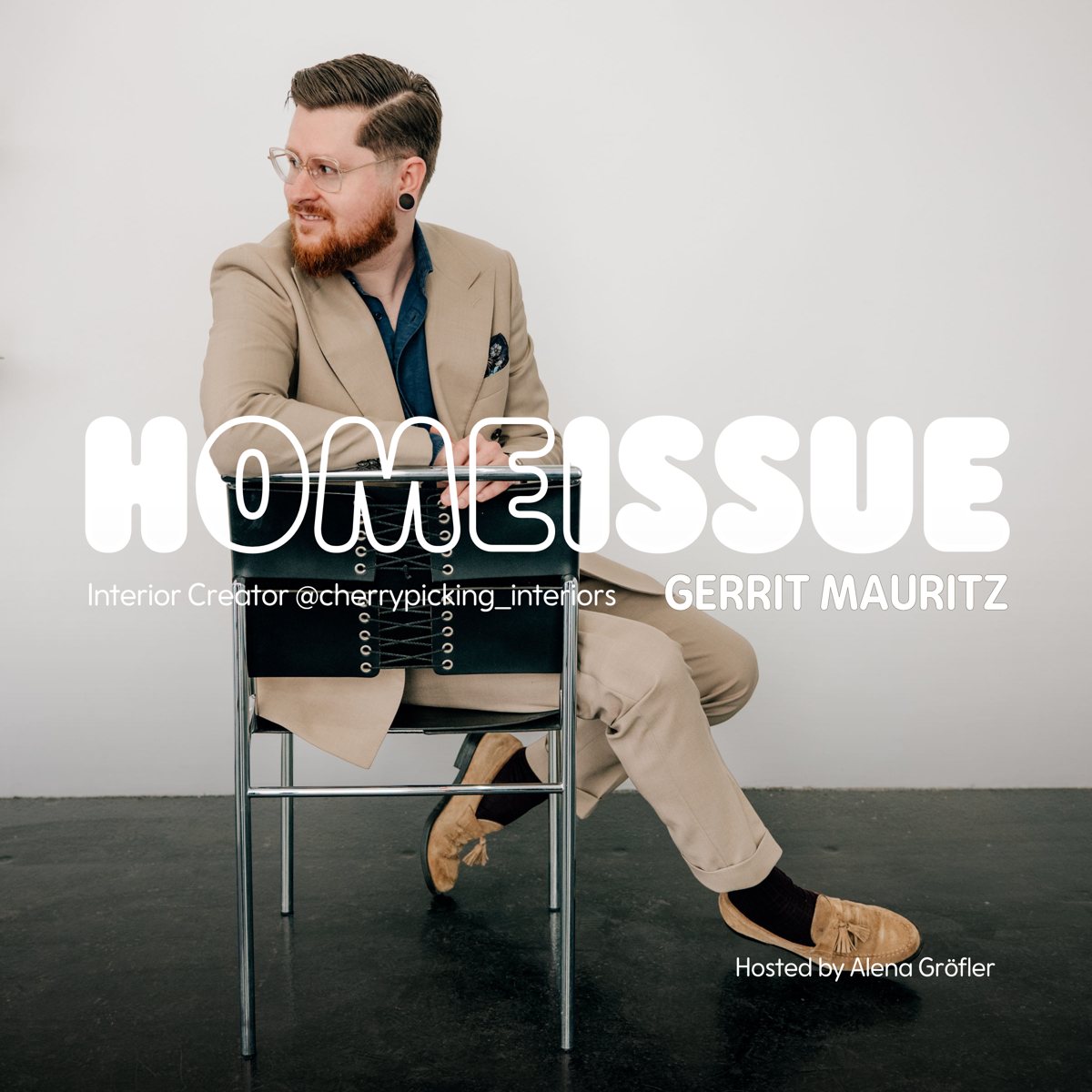
Gerrit Mauritz studied history in Germany and worked for a long time at a university chair for tangible and intangible cultural heritage, with a strong focus on architectural history. Today he lives in Vienna and is employed as a research associate at a university. Almost three years ago he began showing his apartment on Instagram, and for about nine months he has been explaining design classics there in Reels. Brands whose products he once bought himself as a fan are now approaching him. In conversation with Alena Gröfler, he explains what sets the design industry apart from fashion and how he lives himself.
HOMEISSUE Tell me how you started your account Cherry Picking Interiors.
Gerrit Mauritz Nothing I do on Instagram really came about because I had worked out a big plan. Mostly it was other people who said: come on, Gerrit, why don't you do it. It started, I think, almost three years ago. Friends were visiting and said: your apartment is actually so beautiful. It's far too much of a shame that only people who visit you get to see it. So I started uploading photos of the apartment to Instagram. That went very well for a year and a half. At your first 3,000 followers you do start thinking about how more people can see your content, and Reels work extremely well on Instagram. So at some point I started making videos. They were very clumsy. For about nine months now I have had an established format in which I explain design classics and the stories of the designers behind them.
He specialised in these stories because of what he studied. Anyone who deals with architects and their buildings inevitably also comes to furniture and interiors, and that has always interested him a great deal. When he finished his studies and earned his first real money, he searched willhaben for things he knew from his lectures. "And bit by bit my apartment filled up with classics of the 20th century," he says. Today he mixes them with contemporary designs by designers who are still alive.
A WASTED TREASURE
For brands it's exciting that you don't just show designs but explain them. How does a collaboration with you work?
There are really two ways. Either there is an object that I find particularly beautiful and whose story I find interesting, and then I approach the brand. Or the brands approach me and say: we really like your content, that you explain things and don't just film them. I think you do the objects more justice when you tell their story and the ideas behind them, and when you actually touch them and use them. When you're at trade fairs, people tell you a great deal about their furniture, lights and objects. And when you then look at the marketing, it's very often just pictures. I think it's such a wasted treasure, especially for brands that have been around for a long time and reissue designs that were perhaps already on the market between the thirties and the seventies.
For Gerrit Mauritz this is a gap in the market. In fashion and jewellery, he says, there is a completely different awareness of storytelling and of a certain aura around objects. "I don't have a Rolex, I can't afford a Rolex, but I still know what a Rolex is." In design, people might know the Eames Lounge Chair, which you buy once you have somehow made it.
Why do you think there is this discrepancy?
I think it's mainly because brands that sell furniture don't advertise to the end consumer but to intermediaries, meaning architects and interior designers, and because they rely very heavily on their dealer network. But when you work with an interior designer and she suggests a chair that costs 800 euros, that's a serious number at first. Even when the educational process then begins, it takes an enormous amount of persuasion. But if people have seen that Gerrit already explained it on Instagram and they understand what it is, much less persuasion is needed. There are two or three brands that do this very well, USM and Vitra. And there are so many other very good designs that also deserve to stand in all our homes.
The same applies to counterfeits. Alena Gröfler mentions an earlier episode with the CEO of USM Germany, whose brand explained on TikTok why it makes sense to buy the original. For Gerrit Mauritz this is a very good example. In his view the problem of dupes cannot be resolved legally, and in fashion the idea arrived long ago. "But if you buy a fake bag, then you're a faker yourself." In furniture, by contrast, there are people on Instagram who promote dupes. "Yes, then you've bought a Flowerpot for 30 euros from AliExpress. But it just isn't a Verner Panton Flowerpot." Brands, he says, need to charge their objects with meaning far more themselves, and storytelling helps enormously with that.
WHAT MAKES A CLASSIC
Not every good piece of furniture becomes a classic. What does a piece need to reach that status?
I think it needs a certain recognition value that departs from the norm. That can be through the form or through the material. Often it also comes with a step forward in technology. Second, it needs an established name. And something you shouldn't underestimate: in art history, "design classic" is actually a frowned-upon term, because in the end it's also an advertising word. That's why it also takes good marketing by brands that hold on to objects for a long time and produce them over a long period, so that things reach people's awareness at all. Those are the three points, that's the minimum. And even if you have all of that, it's far from certain that it will become a design classic.
HOME
How would you describe your own home?
I live in a period apartment in Vienna. In terms of style it definitely has a Scandinavian foundation, and on top of that I build eclectically with design classics from Italy and from Germany. There is definitely a certain tension in the way the objects stand next to each other. A lot of things are second-hand. We have a beautiful chest of drawers where I don't even know whether there's a name behind it. I think it's this mix that makes it what it is for me.
What does home mean to you these days?
On the one hand, of course, it's a space where you come to rest. On the other hand, my home has now also become my workspace. It matters that the way my home is furnished fits with what I show on Instagram. And of course it's also a certain curation of my own personality that I want to express with it, something serious that is also a little playful. So, for example, I wear suits in my Reels. The overall picture has to fit. At least that applies to the rooms I show. I rent, and the kitchen and bathroom don't meet my aesthetic standards. But in the end you show on Instagram what you want to show. And who knows, perhaps that will change with the kitchen or the bathroom in the next few years.
When Alena Gröfler remarks that on the Viennese rental market you often have to take what does not quite match your own ideas, he replies: "Yes, and we haven't done badly at all. It's not like that. It's complaining at a very high level." The apartment is in the ninth district, and on warmer days you could even sleep with the window open. "So it really is a good location."
You can furnish beautifully with Ikea pieces and second-hand things, he says. For him, home is an extension of one's personality, including when you invite friends, because you want to be a good host. "If you have those resources, then in my opinion you should use them."
The full conversation with Gerrit Mauritz is available on the HOMEISSUE Podcast with Alena Gröfler.