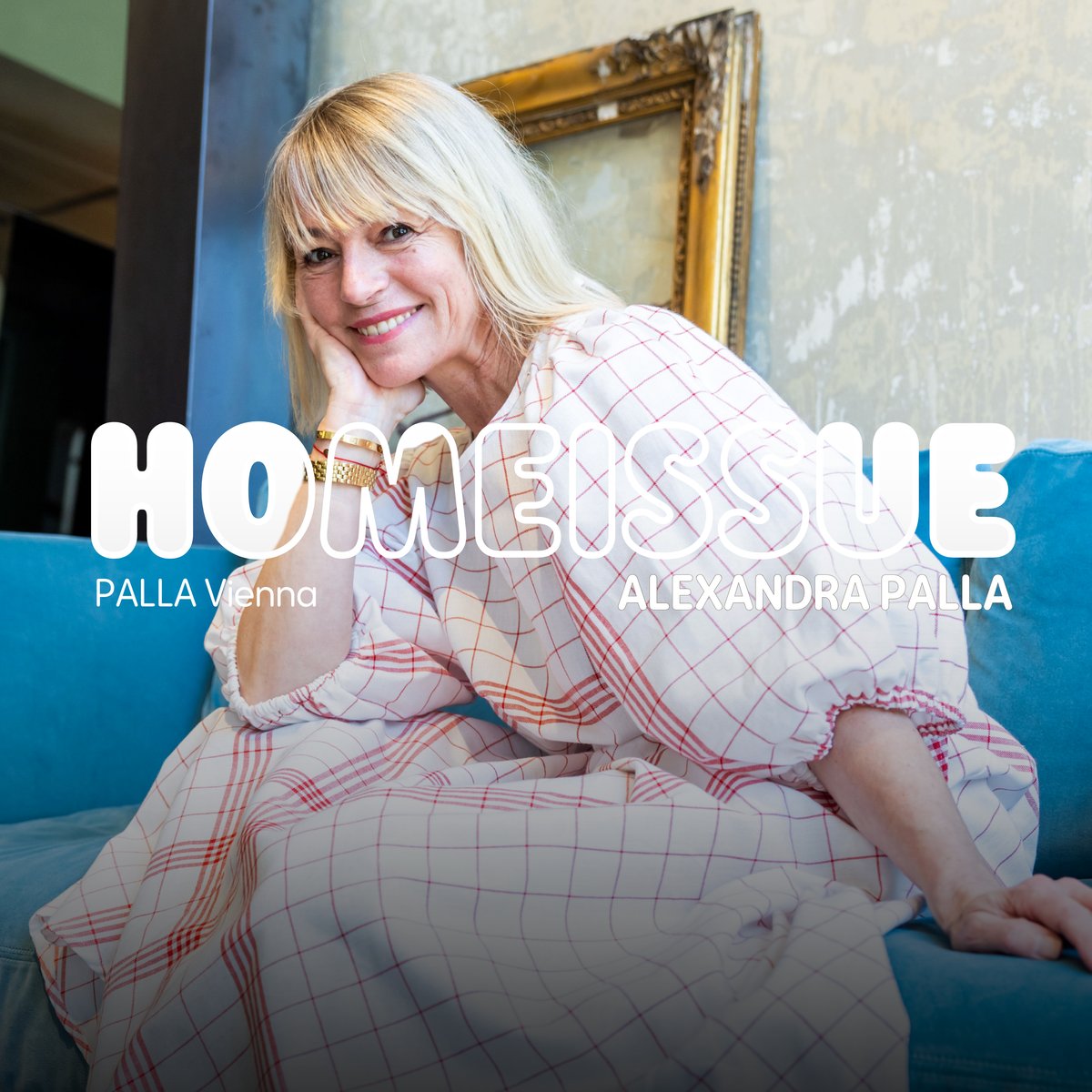
Alexandra Palla is a trained textile technician and completed her training in Vienna in the late 1980s. For decades afterwards she worked in other industries, built teams in media companies, ran a food blog and launched the Austria Food Blog Award. Her fashion label PALLA Vienna grew out of a dress she had made for an appearance on a cooking show on ORF, Austria's public broadcaster. In conversation with Alena Gröfler, she talks about what she took from her grandmothers, why you don't necessarily need a design degree to run a design business and how she lives.
HOMEISSUE You come from two entrepreneurial families, a family of ham makers on one side and textiles on the other. How much entrepreneurial thinking did you pick up at home?
Alexandra Palla A great deal, because I grew up with very strong female personalities. When I think of my grandmothers, both were very, very self-assured, strong women who shaped me a great deal from my earliest childhood. They gave me this sense of it being a matter of course: I can be an entrepreneur too.
One grandmother looked after the wholesale side of the ham business. By four in the morning she was already out with her VW van, her chauffeur and her staff. The other grandmother studied medicine in the 1920s, at a time when it was not usual for women even to finish secondary school.
NOTHING IS IN VAIN
You trained as a textile technician. How does what you learned help you in your work today?
An incredible amount, and for decades I pushed it aside or, rather, paid no attention to it. I always come back to this point when my daughters ask me for advice about training or interests: nothing you do in life is ever in vain. At some point you will need that knowledge. How much did that school influence me? A lot. When I founded PALLA Vienna, it helped me a great deal.
Alexandra Palla has founded many things in her life, including a kindergarten. What always works, for her, is courage and self-confidence, believing in yourself and being able to inspire others for your cause. In every company, association and network she has founded or launched, whether founding teams, teams in media companies or the Austria Food Blog Award, she understood from the start that "you are only ever as good as your network and the people you can inspire." Her advice: "Think of the biggest possible thing. Have a big vision."
In an earlier episode, a designer said it is essential to study design before founding your own design business. How do you see it?
Intensive engagement with the subject is definitely necessary. But it doesn't necessarily take an academic education. No training can cover everything, and there are specialists for contracts or logistics. You have to be a good networker and know where to find your experts. But you have to be good in one area. As an artist I don't have to be a logistics expert, but I have to be good enough to judge whether my logistics partner is the right one and whether he shares my vision.
THE TEA TOWEL DRESS
When ORF invited her onto cooking shows, her appearance mattered a great deal to her. She asked herself how she could embody what she does visually as well, and immediately remembered fabrics she had seen on a visit to a weaving mill. She had samples sent to her and thought: this is it.
How long did it take before you were holding your first products in your hands?
It happened very quickly, I would say a few weeks, because I had the prototype in my head straight away. I remembered a wrap dress my grandmother Berta wore, the one who represented the wholesale side of the ham-making family. She loved wrap dresses, that was her work uniform, made of very thick, firm, sturdy work fabrics in black and white. So the shape was clear, it had to be a wrap dress. The fabric was clear too: the classic kitchen check in red and blue. The prototype was finished straight away, and then I said, let's make three or four right away, who knows what I'll need them for.
After her first cooking appearance, ORF's customer service got in touch, internally, with questions: "What cooking show was that? Who appeared on it? Who was wearing that tea towel dress? Our phones are ringing off the hook. Everyone wants that dress." For Alexandra Palla, that was of course great. Because she thought of the dress as a concept from the start, the questions of a company name, a logo and a corporate identity arose.
She did not start from zero. Her food blog already existed, with an online shop, along with contacts to international clients and appearances at international trade fairs. She compares it to a bicycle when you shift into the next gear: she was already on the right cog and only shifted up one more gear.
THE RED THREAD
What does good design mean to you?
There is this idea of form follows function. Ideally, good design is always something very practical as well, something that tastes good, feels good, is well judged. The most beautiful stall at the Kutschkermarkt, for example, is the tulip stall of my friend Wolfgang. He only has tulips. He concentrates on the one product, and that is incredibly beautiful, the aesthetics of the product, of nature and of freshness.
Even the check, a very structured and linear pattern, can be staged even more strongly, she says, if you cut it on the bias, use it diagonally in a wide skirt with generous folds, or let the checks not meet at seams such as the armhole. "Often it's this break in pattern or colour," she says. The same can happen on a plate. For her, three pieces of asparagus on a plate are always more beautiful than two or four.
You do so many different things, and yet a red thread runs through your projects. How would you describe it?
It does have a bit to do with the phases of my life. When the children were small, I loved cooking for them and wanted to write the recipes down. Then the cooking blog was there. And then the focus shifted more towards outfits and design, and then PALLA Vienna was there. At twenty you don't know where the red thread will lead.
HOME
How do you live yourself? What matters most to you at home?
Many things go into the feeling of a home for me. This may sound strange, but temperature, in the sense of not only the warmth itself but also the colours, the acoustics and the possibility of letting light into the rooms. That is very important to me. That's why I have a large kitchen-living room with lots of views outside, where the sun comes in beautifully during the day.
Accents of colour also matter to her. She loves painting walls and picks out a few surfaces that she paints in different colours, which can change every year or two. The red wall visible behind her during the conversation is painted in Atomic Red, a colour from a very beautiful English paint company with wonderful pigments, which reflects beautifully with every change of light.
Over the years she has noticed that she likes rooms with character. She then asked herself what gives rooms that character, just as with an unmistakable look you wear when you go out. "What is your unmistakable look at home?" For her it is a good mix of very personal things from the family, heirlooms and old china, combined with new things, with cotton and patterns. "I love checked tablecloths," she says. "But I think when people see me, they can immediately imagine how I live."
When you walk into your home, what is the first thing you see?
A large, practical coat rack with lots of hooks. Ideally you don't first have to dig your way through a buried entrance, but step into a room you can take in.
Her most important tip as an entrepreneur may be a little worn, she says, because a bank uses it as its slogan. "But somehow it comes down to this: believe in yourself."
The full conversation with Alexandra Palla is available on the HOMEISSUE Podcast with Alena Gröfler.