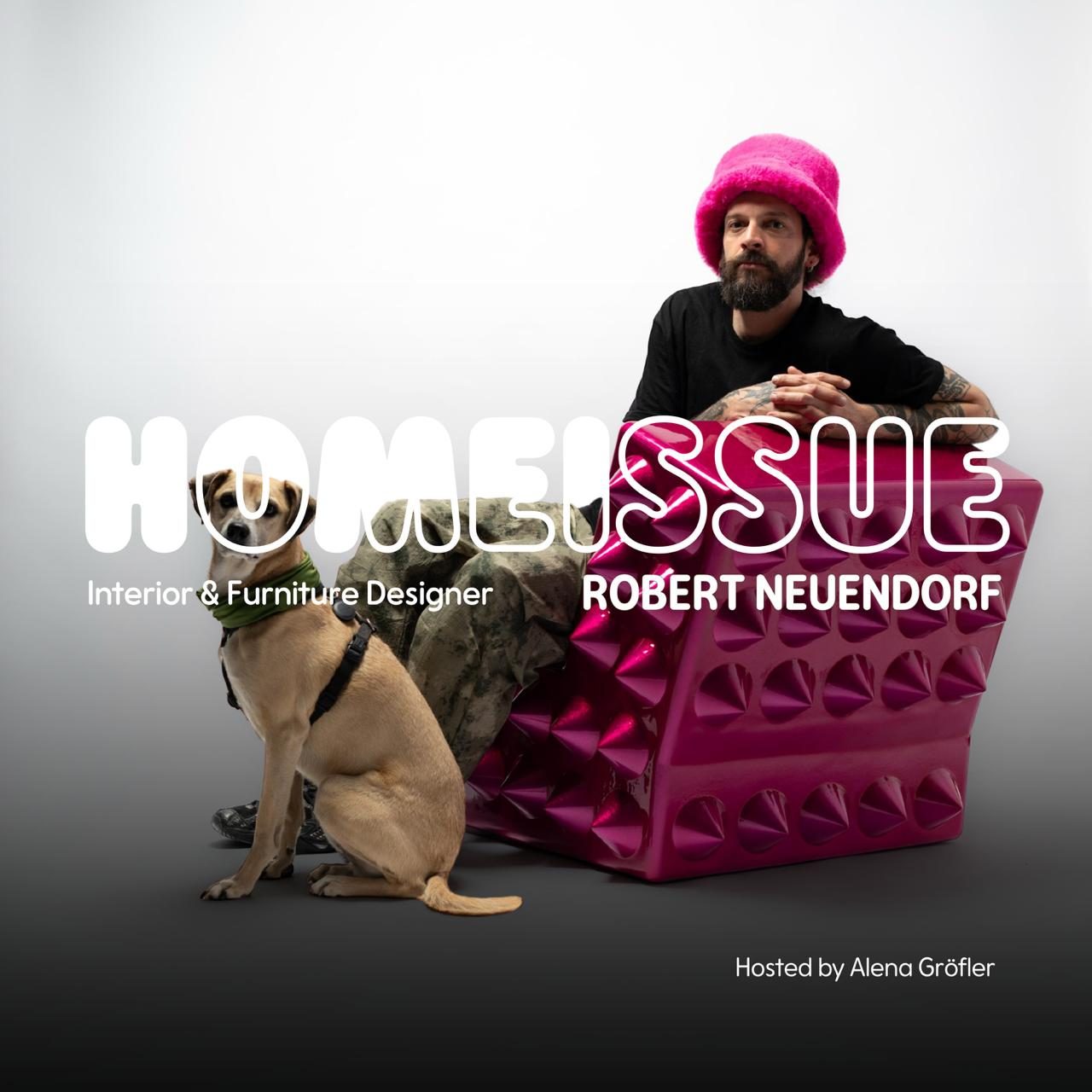
Robert Neuendorf studied illustration in Hamburg and comes from the urban art scene. For four years he co-ran the Affenfaust Gallery, which mainly exhibited urban artists. He then built up his own interior design studio, which, as he remembers it, he gave a name in 2020. The conversation was recorded in early April, shortly before he presents his first furniture collection, Urban Signals, at Milan Design Week. In conversation with Alena Gröfler, he explains why he hid behind other people's art for so long, why his spaces don't aim to be comfort zones and why he talks openly about money.
HOMEISSUE How are you feeling so close to Milan Design Week?
Robert Neuendorf I'm very nervous. It's a very exhausting time, but also incredibly exciting. At Design Week I'll be launching my first furniture collection, called Urban Signals. I'm proud, but I'm also really nervous that something will still go wrong on the way there. It's a dream I've had for a very long time, and now it's becoming reality.
At the time of the conversation, the first of the three seating pieces has been finished for three days, complete with its final clear coat. About forty-five minutes after it was done, Robert Neuendorf sat in his car and cried for half an hour. "A lot of pressure fell away," he says. He has been working on these pieces for almost a year, and he never thought it would be so demanding.
AFFENFAUST
While still at school, Robert Neuendorf was spraying graffiti and street art, and at university he developed a character of his own. Soon after, he was invited to exhibit as an artist, and afterwards the gallery asked him whether he wanted to join. That was how he became one of four young people running the Affenfaust Gallery.
The gallery showed a new exhibition once a month, and lots of people came to the openings. "Standing there as a young guy in my early twenties, in the middle of it all in a suit, always presenting the art, didn't do my ego much good, you could say." Eventually the other three asked him to leave the gallery. For him it was "a complete plot twist", and today he is glad about it, because otherwise he wouldn't be where he is now. "Yes, but it was definitely down to this ego thing. I know that today. I didn't understand it back then."
SPACES THAT TRIGGER SOMETHING
How did you get into interior design after the gallery?
At first I really turned my back on art. It hurt me enormously, and for a while I avoided lots of exhibitions. During my gallery years I had completely neglected my own art. There wasn't much room left for it, or rather, I always found the art of the others better. But today I know that I was really hiding behind other people's art. Of course I didn't make myself vulnerable by showing their work. An exhibition like that can be reversed relatively quickly, but your own art feels as if it's carved in stone.
After he left, he worked, as he believes, for two years with a carpenter and a roofer and learned a great deal about wood-based materials. Then requests came in from the nightlife scene, where he had worked during his gallery years. He was asked to smarten up a bar counter or redo a back bar. "But they were just really thankless tasks and jobs." People didn't know what was going on in his head, so first he had to build a portfolio. A marketing agency run by friends helped him build a brand that unites interiors and art. That, he says, is also a little bit "my aspiration, my credo, to create spaces that feel like artworks".
You once said that you don't design comfort zones but spaces with an attitude. So don't people feel comfortable in your spaces?
I think my spaces create emotions, and unfortunately that happens relatively rarely in our time, because so often people only think about profit. Let's take an owner-occupied flat: whoever buys that flat will surely design it as neutrally as possible, so that it appeals to as broad a public as possible. My spaces don't do that. My spaces are not crowd-pleasers, if you like. Provoke is a bit harsh, but they definitely trigger something. I'm into Memphis design, I'm into Space Age, I love Brutalism. These are all spaces that immediately trigger emotions in me.
URBAN SIGNALS
How did your own furniture collection come about?
In 2024 I went to the Salone del Mobile in Milan for the first time. I already had a strong affinity for design objects and the classics, but I hadn't touched or sat in many of them. That had a huge effect and set a lot in motion. I left and realised: furniture is exactly what I want to do.
What are your pieces made of?
There are three seating pieces, and each one is made of a different material. The pieces are all named after animals, because their colours look like animals. There's the Wasp, a two-seater bench made of wood. Then there's the Zebra, a garden armchair in stainless steel. And then there's the Hedgehog. It's inspired by defensive architecture and has spikes, but they're presented in a cute way. The subject itself, pushing homeless people, or people in general, out of public space, is incredibly sad. I took it up and covered it in a bright pink metallic-flake lacquer and in that way made it more inviting. The Hedgehog is a kind of lounge chair, relatively low, and it's made of fibreglass.
He wants to give part of the proceeds to an organisation in Hamburg that supports homeless people, "because that's the only thing that feels fair". Each piece is released in an edition of 18. He wants them to be seen more as art objects. "You can also simply use them as furniture. But you can definitely tell where I come from."
Robert Neuendorf talks openly about money. He financed everything himself. In times when no commissions came in, he had to dip into his reserves again. The van alone that he is driving to Milan in costs 2,300 euros including fuel. He had part of the furniture produced in China, after comparing prices from Portugal to Lithuania and China, and in the end China was the cheapest option. It mattered to him that the goods came neither by plane nor by ship, but by train. So that the shipment would be delivered on the same day after customs, he paid another 600 euros on top. "And that's all just stuff nobody talks about." He is such an honest guy, he says, "but I know that it also makes me pretty vulnerable."
In Milan he won't have a fixed exhibition venue. Instead he will put the furniture out on the street in a guerrilla marketing campaign and move with it through different parts of the city, because the collection is inspired by urban space. He once heard that every designer should make a chair at some point in their life. "I've definitely ticked that off now, and it feels really good."
HOME
Does your studio also design private homes?
In interior design you cluster things into three areas: hospitality, commercial and residential. Residential has come up, but it's relatively limited, because I have the feeling that Germany is quite a difficult market. People have a very strong DIY culture, which is actually lovely, but of course it works to my disadvantage. And I would really love to do private spaces.
The best example of this comes from his own apartment. Famtastic, a Hamburg online magazine, visited him there for a home story, and it was "really lovely". A few days or weeks later he ran into an acquaintance on the street who had seen the feature. You really inspired us, the acquaintance told him, and they had now started painting their wall blue too and had put up stripes as well. Robert Neuendorf was pleased to hear it, and at the same time thought it would have been great if they had come up with something together. "And yes, that's kind of a thing here, I feel." When Alena Gröfler points out that he did at least inspire someone, he agrees: "Yes, it's wonderful. Absolutely."
The full conversation with Robert Neuendorf is available on the HOMEISSUE Podcast with Alena Gröfler.