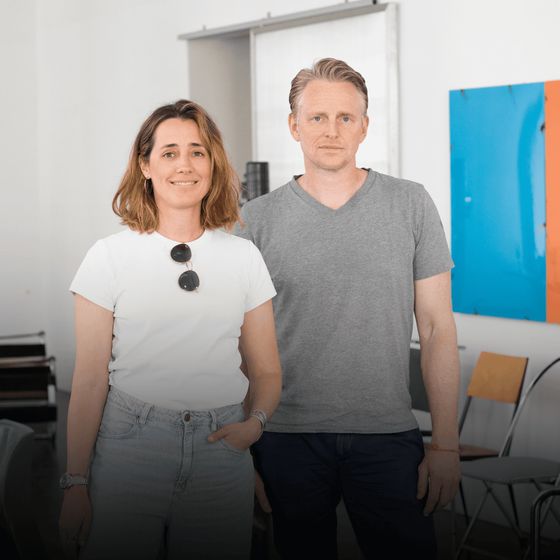
Anna and Michael Trubrig both studied economics and lived abroad for many years, most recently in London. In 2013 they had the idea of opening a showroom for European design in New York. That idea became Stillfried, which today furnishes mainly hotels and restaurants. Later they founded the Austrian design label The Form Follows. The couple have three children, the third of whom was born in America. Four or five years ago the family moved back to Vienna, but every month one or both of them travels to the US to run the business there. In conversation with Alena Gröfler, they explain why Americans don't want to see screws, when the tariffs arrived and what you learn about living when you move all the time.
HOMEISSUE You're married, you have three children, two showrooms and, on the side, a design label of your own. What's your secret when it comes to time management?
Anna and Michael Trubrig We get very little sleep. But we also have a lot of support, and within the family people help each other out again and again. We're regularly late, or we agree to things that we then have to cancel or postpone at short notice. So we're not exactly time-management wizards.
The idea for Stillfried, as Anna Trubrig tells it, came a little out of nowhere. At the time she worked for PR agencies in the arts, while her husband worked in finance. His suggestion was: "We'll go to New York, but we'll open a showroom for European furniture." She was "sceptical, of course", was talked round and came on board. Looking back, it was very lucky and also very naive, because the two of them knew nothing about the furniture industry and had never lived in America. "And in hindsight we were completely undercapitalised." The first years were extremely hard-working and physically at the limit, and at some point it began to grow.
WITH A TOUCH OF ARROGANCE
The original idea was to act as a link. Many European brands that are not among the very largest cannot gain a foothold in America, because a presence of their own costs a great deal. The couple wanted to help mid-sized furniture companies build a foothold in the US. "But it then developed very quickly in the direction we're in today," says Michael Trubrig.
What do Americans love about European design?
What Americans like was something we hadn't really thought about in advance. We came to America a little naive and perhaps also with a touch of arrogance. We thought: German quality and Austrian design, who would say no to that, and once we're there they'll beat down our door. It's not quite like that. To be completely honest, Americans don't care all that much whether a piece of furniture comes from Europe.
WHAT SELLS
Your showrooms give you direct access to the market. Can you tell quickly whether a product will work?
No, unfortunately not. It's incredible how often we've been wrong. We thought, wow, this is going to do so well, and then it didn't sell at all. And the other way round, some things sell and you think: okay, interesting. For me the best example is TON. They commissioned the Merano armchair, which really is one of their main revenue drivers, so that they would have something a bit edgier that might get them into the press. Now it's probably one of the bestselling armchairs.
The couple do know a few parameters by now. In the contract market, Americans are very reluctant to see hardware, screws for example. If a screw is visible, they tend not to buy it. A lot of it, though, is "really a great deal of luck". If a piece ends up in a bigger project, it starts to sell itself a little more, because others then say: they have it, we'll take it too.
A LABEL OF THEIR OWN
Behind The Form Follows lies "a little bit also the wish for greater self-determination". Stillfried is a classic retailer, and there branding and corporate identity are less central. America comes into their thinking when it comes to stability in the contract market, and here too there is no visible hardware.
How does a new product come about with you?
There are two routes. External designers approach us with a product, whether it's a finished piece, a prototype or an idea. We keep working on them together, and that's where our expertise comes in, so that they become series products. The other route is in-house. We think about what we're missing, and sometimes Pia or Iris already have something in mind. Then it's discussed within our small team in Vienna and developed from the very start, and everyone contributes their own expertise, whether that's the financial side or the technical side.
The lead time was financed from Stillfried's cash flow, and in total it took almost four years to build up a product portfolio. Then, roughly in the last year, came the phase in which you build an enormous number of prototypes, order stock in series and hit peak negative cash flow. At exactly that moment the Trump administration decided to introduce tariffs, and Stillfried suffered badly. The couple speak very positively of a grant from the Vienna Business Agency, a direct subsidy for the project.
They don't offer young designers many illusions. Building a label alone is financially almost impossible, they say, and sometimes they advise joining forces in a collective, at least to share resources. One demand has already earned Anna Trubrig a few boos, "but I stand by it," she says. Design degrees need a business component, because the step from a first design to a product you can actually sell is an extremely long one.
HOME
You lived in America for a long time and now you're back in Vienna. What does your home look like?
That's a funny question. When we were in America with our two small children, and the third was then born there, we got asked that question early on as well. And we had to say: better not visit us. Everything was still very shabby, we couldn't afford anything, and it was all in a very small space. Here in Vienna we're lucky enough to live in a very beautiful apartment in the third district, and now that the children are almost grown up, we've actually furnished it with pieces from our portfolio. Pieces from The Form Follows, of course, but many brands we represent at Stillfried have also found a home in the new apartment.
You've moved a great deal. What does that teach you about living?
You probably learn more about moving than about living itself. We've moved eight times in eleven years, as two, three, four and five, across continents and different cities. We're very good at packing boxes. What we have learned is that you don't actually need everything. We're both the kind of people who like to clear things out rather than pile them up, because we've noticed that you can get by quite well with little. And you learn that you can make yourself a bit of a home anywhere.
Each of them grew up in a single apartment, more or less from birth. Today they enjoy starting afresh again and again, furnishing anew and adapting their home to their circumstances. That is why they can't give general advice on how to furnish an apartment. "Everyone has to find for themselves what makes them feel good, what gives them joy and what they like." With them it is always a mix of good design, vintage furniture, simple family pieces and things they are simply fond of. There is no shortage of new inspiration, because they buy furniture for their business, "and you can see that beautifully in our home too".
The full conversation with Anna and Michael Trubrig is available on the HOMEISSUE Podcast with Alena Gröfler.