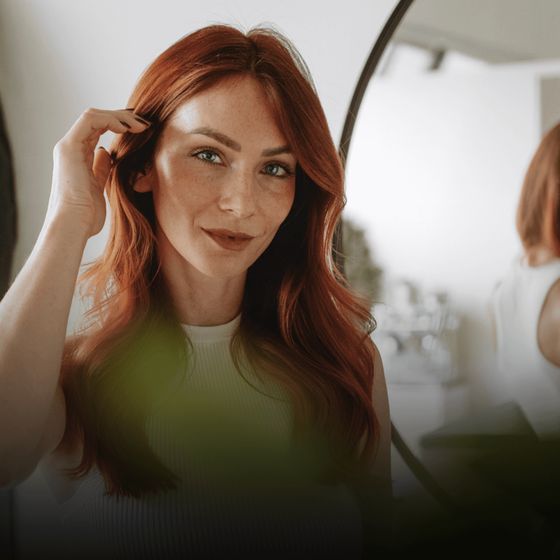
Magdalena Wöckinger started a blog in 2016 and added Instagram in 2018. For a long time she hovered around 20,000 to 30,000 followers there; since Reels arrived, her community has grown steadily and now numbers almost half a million. In 2020 she trained as an interior designer and in the same year founded her company, "einzigartig wohnen" ("living uniquely"). She studied online marketing with a focus on search engine optimisation. In conversation with Alena Gröfler, she explains why her clients mostly find her through Google, what happens to the furniture she builds and why, for all her love of period buildings, she ended up in a new-build.
HOMEISSUE How often, on average, are you at Ikea each week?
Magdalena Wöckinger Once a week on average, definitely. Mainly because I can build things myself, I usually buy fairly inexpensive materials and turn them into something new and unique. These days I go there with a shopping list, and impulse buys have almost disappeared.
Why do you think so many people follow you?
I think it's approachability. On my channels and in my own projects at home, I really try to show how you can build or recreate beautiful designer furniture yourself, or simply make something cool and new out of old things. I think what's special is that I show that design doesn't always have to be unaffordable.
FROM STUDENT FLAT TO STUDIO
It all began with her first student apartment, a "really ancient apartment, terrible". Living beautifully was already extremely important to her, so she renovated it with a small budget and an enormous amount of her own work, without any know-how. Friends and family asked where the bed came from, for example, or who had laid the tiles in her kitchen. The answer was usually that she had done it herself, and then came the question of how. That is how her first tutorials came about. Then she redesigned friends' apartments too, and eventually people from her community asked whether she would offer the same for them. It hadn't really occurred to her that this could earn real money, "because it was always something so natural". The penny dropped with those requests: "okay, wow, they would really use this."
Why did you still do a formal training?
I believe that as a designer you have a feeling that you need to have, one you can't learn. If you have that intuitive understanding of why something works or doesn't, you've actually already won. But it's also great to know the theory: why one colour is better than another, because it makes the room look bigger or smaller, for example, or why you put the light source here and not there.
TWO AUDIENCES
Because her website is well optimised and ranks well for the most important keywords, she gets most of her commissions through Google. She speaks to two audiences. On Instagram she shows people how to make things themselves on a small budget. "Interior design is still a luxury service." That is also why she doesn't build tables for her clients, "because I'm actually not allowed to do that for strangers, I'm not a carpenter". For them she does the planning, coordinates the service providers and tells the painter which colours it should be.
How does a room concept come about for you?
There's always an initial, no-obligation conversation first, either at my office or by video call, where we see whether we're a good fit. Then I always go on site and look at the current state. I let the people flow into my first plans. Are there four of them or two, do they need a workspace, do they work from home?
Commercial clients are often more open to "crazy things", as she puts it. Private homes carry a lot of emotion, she says, and she wouldn't want to miss the moment when someone sees how what was only on paper comes together in real life. "I'm glad I don't have to choose between the two."
CONTENT, HONESTLY
Magdalena Wöckinger develops the ideas for her videos herself. Since the start of the year, her boyfriend, who runs a film production company, has been helping her with filming and editing. Moving in together was an adjustment at first, too, because until then she had always had completely free rein. "And now suddenly there's someone who also has an opinion." They change things around almost every week.
What do you do with all your DIY creations?
As a content creator you have to be honest: at some point you produce a lot for the community, you look at the trends, at what's in demand, and you run polls. At first I built a table because I needed it. Then came the shift to asking what is working well right now. A large part stays, and a lot ends up in our big office. I actually take many things apart again and use the material for something else. For a while I had an Etsy shop, but I closed it again for logistical reasons, because they're often large, fragile things. Now I'd rather give them away in the community or to friends.
With collaborations, it is important to her that a brand fits her values and can be woven authentically into her content. Because Reels vanish from the feed so quickly, her community kept asking for a collection, and then a publisher actively approached her. The book contains just under 60 DIY ideas, almost all of them new, which she shot on top of her daily content. She underestimated the effort, but "it definitely paid off".
HOME
How do you live yourself?
That changes a lot with every apartment, because I approach my own home exactly as I would a client's. The first step is to look at the shell of the space. Before, I lived in a period building, where I worked with stucco and wall recesses and with light materials to pick up the beautiful oak floor. Now I live in the complete opposite, a loft-like new-build apartment with very, very high walls and really just one large room. We have a very dark wooden floor and lots of steel elements that were already in the apartment, like a fireplace or columns. I just couldn't see all the beige, the light wood and the cream tones in the new apartment. Now I work with metal surfaces, with aluminium, with steel and with darker tones, almost an industrial style.
And yet she had always said she wanted a period building. She and her boyfriend had already decided on a period apartment with a roof terrace, for her a "one in the lifetime" moment. Two days later their current apartment came along; they walked in and both knew it was the one. If you showed her both apartments on paper, she would say: "I'm a period-building girlie forever." "But honestly, I've never felt as at home in an apartment as I do right now."
What does home mean to you?
Home is simply a feeling. Especially when you're looking for an apartment, the most important thing for me is that you walk in and simply feel it, that you can instantly imagine it being home. Then other things, like the herringbone parquet, suddenly become secondary. Things have changed a lot when it comes to furnishing, too. I used to be a real minimal beige girlie, everything very clean. When someone said my place looked like a magazine, that was the biggest compliment for me. That has changed, probably partly because of my boyfriend. We now have much more life at home, things we brought back from holidays, for example.
She looks for this with clients, too. Anyone who walks into an apartment should get a feeling for the person who lives there, rather than see a perfectly styled, run-of-the-mill apartment you could copy and paste. For anyone with little space and a small budget, she has a tip that works in any room: light in layers, meaning a base light on the ceiling, zone lighting where you really need it, accent lighting for pictures or walls, and mood lighting, with candles for example. Today it feels to her as if she spends the whole day pursuing her hobbies. For a long time it was different, when she worked at a huge corporation. "It really is the greatest happiness in the world," she says. "I value it very much."
The full conversation with Magdalena Wöckinger is available on the HOMEISSUE Podcast with Alena Gröfler.