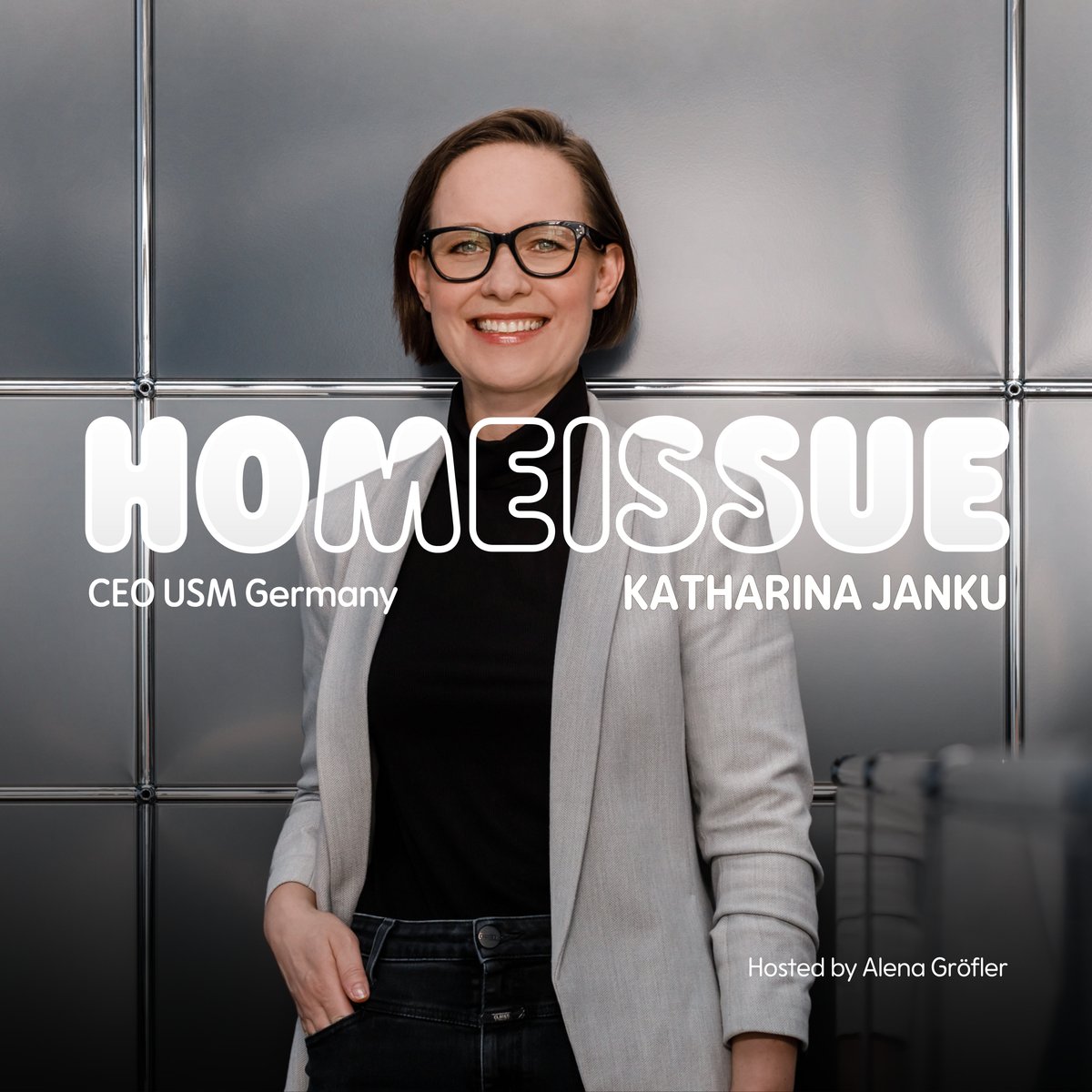
What began in 1885 as a locksmith's workshop in Münsingen near Bern is today one of the best-known design brands in the world. USM stands for Ulrich Schärer Münsingen, the company is still owner-managed, and its furniture system is sold in more than 40 countries. Katharina Janku has worked for the brand since 2016, first as a marketing team leader and since 2022 as Co-CEO of USM Germany. Since 2024 she has also been responsible for human resources across the entire USM Group worldwide. In conversation with Alena Gröfler, she explains why she sometimes still has to explain USM, what she learned from a manager at the Städel Museum and how she lives herself.
HOMEISSUE What path did you take to become CEO at USM?
Katharina Janku It started at sixteen. I did an internship at the Kunsthalle Mannheim as part of a careers programme at school. After my final exams I actually decided to study art history. Then I had a stint at the Städel Museum, almost the classic route, although even there I worked in marketing. From there I went to an educational services company, and in 2016 I joined USM as a marketing team leader. So it was absolutely not a straight path. In my late twenties I had no idea that I would one day have such a wonderful job.
What qualities do you need to run a company like USM? And what did you have to learn first?
It helps enormously to always be curious and to want to know things. In a CEO role you work more as a generalist, so you should be keen to take on entirely new disciplines. At USM it is also important to be able to look back into the past, almost the way I know it from art history. I had to learn a few new things. For example, I did an Executive MBA, classic business administration. And I'm very hands-on, someone who makes things happen. In a leadership position that no longer works the way it did when I was a team leader. I had to learn to keep a bit of distance and to let go.
When Katharina Janku talks about her career, one situation stands out. She is still an intern at the Städel Museum, and the museum is in the middle of a huge campaign, "Frankfurt builds the new Städel", which the media cover sometimes positively and sometimes negatively. Her manager, Inka, tells the team: "I'll stick my neck out. You make sure it stays on." For Katharina Janku this was hugely formative, because you felt a great deal of freedom and knew that someone trusted you, while at the same time carrying responsibility yourself. "And it is still my mantra today," she says. Since she has had staff of her own, she keeps asking herself whether she handled a situation according to that mantra or whether it was not the right way after all.
FROM LOCKSMITH TO DESIGN ICON
Until the 1990s USM was not a design furniture company at all and mainly sold window fittings. What the company still does best comes from that era: cutting steel tubes, bending sheet metal and powder-coating with a precision that, according to Katharina Janku, few can match. The furniture system was created for the company's own use. Paul Schärer and Fritz Haller expanded the site with a modular steel building system, a pavilion of glass and steel went up in Münsingen for the administration, and the old wooden roller cabinets no longer fitted in. In August 1965 the patent for the ball-and-tube connector was filed. "It's really a product of chance," says Katharina Janku, born of the partnership of two people who dared to say that they would simply build their own furniture.
For a long time, people knew USM mainly from offices, the dentist or the lawyer. How did the brand find its way into living rooms?
I believe USM was always present in private homes as well, just not as visibly. By 2015 at the latest, our fiftieth anniversary, we really turned things around and opened up with the campaign "Make It Yours". When I started in 2016, I quickly began working with influencers for the German market, today you would say content creators, to make the whole thing more approachable. The question, of course, was how sexy a lawyer's furniture could still be. In recent years we have definitely noticed that our audiences have become much younger.
USM is now even on TikTok. For a long time the team hesitated, and Katharina Janku calls it "shy". Then USM launched a campaign on whether or not to buy the original, because copies were being held up to the camera on TikTok. The response, with plenty of interaction and engagement, surprised everyone a little. For her, it is essential to show up on new platforms too and not leave the field to others.
WHAT MAKES A CLASSIC
What turns a design object into a design classic?
Very strong recognition value certainly helps, meaning that form, material and colour stay in your eye. Then that the quality is right and everything is precise. And it is certainly also a matter of restraint. Everything it doesn't need must not be on it, otherwise it becomes kitsch. It is also part of it that not everyone loves a design classic. I think you also need rough edges for something to establish itself. And you have to be timeless. That is probably even the most relevant thing of all.
For Katharina Janku, restraint is not a one-off decision but an ongoing process. "Being a design icon means restraint, a great deal of restraint," she says. That means genuinely debating with colleagues and asking again and again whether something is needed or whether things need to be pared back. The team keeps an eye on trends, but you don't have to ride every one of them. Her guiding principle for this is an old proverb: the cobbler should stick to his last.
How does a traditional company deal with the pressure around sustainability?
We simply are it. At first our production causes relatively high CO2 emissions, because our raw material is steel and we powder-coat. But all of that pays into the longevity of the product. Once bought, it is used again and again, replanned and reconfigured. At the beginning we actually found the subject quite hard, because it is something we have always been. One thing we did: we were the first furniture manufacturer to commit to the Science Based Targets.
HOME
How do you live yourself, and what role does home play for you?
Home is incredibly important. I like spending time at home, and I'm an advocate of working from home, though not five days a week, because then the walls would close in on me. I travel a lot for work, and that makes home all the more important, because it's your habitat. I live in a rather clean, modern style. My mum already says: if one more USM piece comes in, you'll soon have a showroom.
Her pleasure in home goes back to her childhood. Her grandmother, Oma Maria, loved rearranging things, and on some Sundays the two of them rearranged her childhood bedroom, moved the wardrobe somewhere else, painted walls or hung new curtains. Today Ikea is gradually moving out and design classics are moving in. She buys more carefully than she used to and asks herself whether a piece would still fit after a move.
Which design classic, apart from USM, has moved in with you?
A Vitra Lobby Chair, actually an old, historic one. I inherited it from a previous tenant, so it's a kind of indirect heirloom. And then a sofa from B&B Italia moved in, which I simply love, because it's modular too, and that's just fun.
She experienced how useful modularity is when she moved last year. Part of her former USM wardrobe is now part of her kitchen, because the wall in the new apartment is shorter. Still, it doesn't work for her without personal things. A vase with special meaning, a picture or photographs belong in a home, because the mix is what matters. "I don't want to live as if I were in a furniture store or a design magazine," she says. There has to be something personal, but not too much. "I don't tend towards kitsch."
The full conversation with Katharina Janku is available on the HOMEISSUE Podcast with Alena Gröfler.