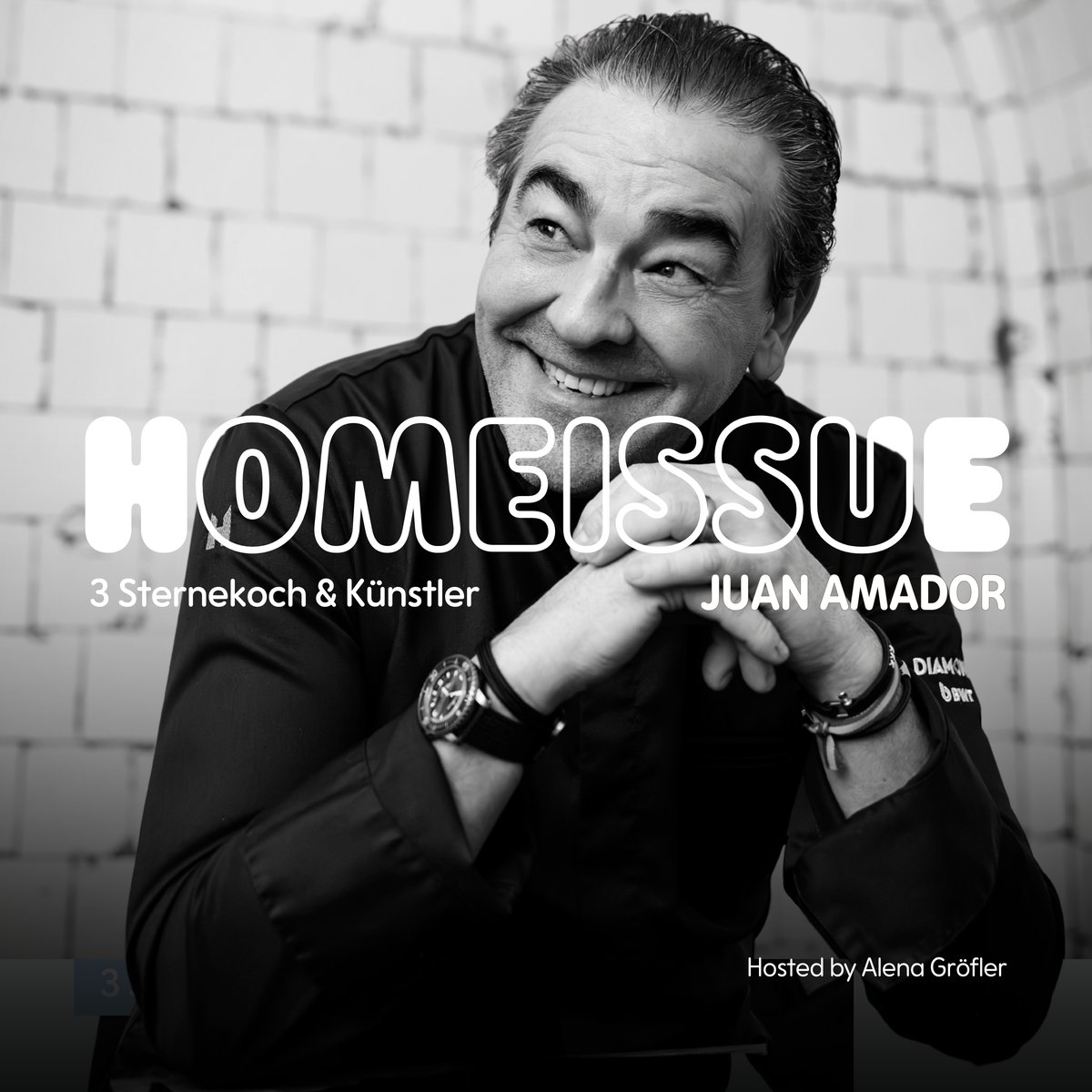
Juan Amador runs Restaurant Amador in Vienna and is the first chef in Austria to be awarded three Michelin stars. The restaurant has two kitchens, and both are open. During the Covid period he began to paint, first under the artist name Rodama and now under his own name. He paints abstract works, mostly at night in his studio, and also shows them in the restaurant. In conversation with Alena Gröfler, he talks about creativity with and without chance, about his attitude to fame and about what a home has to be for him.
HOMEISSUE People know you as Austria's first three-star chef. What does a top chef have to do with art and design?
Juan Amador I think in the kitchen we're always dealing with design. Ultimately, design means shaping things, changing things and perhaps putting them back together in a new way. In art it's similar, but different. People always used to say that we chefs are artists, and I always disagreed. An artist can take his time and doesn't necessarily have to deliver. Because I do both in parallel today, I can back that up quite well. We chefs aren't artists, we're elite athletes. When a new dish is created there may be a touch of art, but after that it's pure reproduction. You have to keep to timing, to certain boundaries or, let's say, laws. And in the kitchen it's very important that we try to make every guest happy and therefore satisfied. Art doesn't always have to please, and art doesn't always have to satisfy. That's the difference.
It really began during the Covid period, when Juan Amador realised that he could no longer give his creativity free rein, because, as he puts it, he was "more or less on day release". At some point he also got bored and thought: why not? "And then it began. Fairly spontaneously, and then very radically too." Friends who are artists advised him to start with small formats and with acrylics. Cooking is similar to painting, he says. There are boundaries, but to be truly successful you have to move outside them and create a world of your own.
RODAMA
At first you made your paintings under the artist name Rodama. Was that a protective mechanism, or did you not care what people said?
No, my self-confidence isn't quite that strong, especially when I'm on unfamiliar ground. That's why Rodama was a certain protection, a kind of small mask, to give myself a few years. It's simply Amador backwards. Really I was wearing a transparent mask. In truth I only did it for myself. Then people saw it, at some point gallerists and artists too, and they encouraged me to go public with it. Then it was fairly clear that the name Rodama simply needed too much explaining. So I went back to my real name, let the mask drop, and now I work in two fields that feed each other wonderfully.
NIGHTS IN THE STUDIO
Do the two inspire each other, or do you keep cooking and painting completely separate?
They feed each other, and at the same time there's a separation, and that's a good thing. It has also changed me personally. I'm usually in the studio before the kitchen and then after the kitchen, mostly at night, and that's where I clear my head. I might then get ideas for new dishes in the morning or around midday, but not through painting; it's because I reach a state of complete calm. And the other way round, the stress falls away from me within seconds, minutes at most, as soon as I'm in the studio. It's a great balance that I've found through it. I wouldn't have expected that.
When you paint, do you already have the finished picture in your head, or do you just start?
I do go in with a certain idea and a certain plan. But it changes during the process, and you take new paths. It's similar with cooking, of course. From the idea to the dish it sometimes changes enormously, and it's exactly the same on the canvas. Because I work a lot with chance in the studio, things emerge that I can only partly influence, and I take great pleasure when something beautiful develops from letting it happen. Chance is completely forbidden in our kitchen. I make up for that in the studio.
RED, MR AMADOR, RED
Juan Amador has little interest in fame. He doesn't normally go to his guests' tables, because that would be a bit like a catwalk, with the same small talk at every table. He is always there for his guests all the same, and they see him, because both kitchens are open. By nature he is "rather shy and reserved, which people find hard to believe". He distinguishes between the figure of Amador, who ultimately does the job, and himself, and that should remain private. "Success is also very important, but fame isn't really what drives me," he says. He keeps telling his people: "What we do is very important. We ourselves are relatively unimportant." He will never be satisfied, because satisfaction brings carelessness, overconfidence and arrogance in its wake. "I'm basically a happy person. I've managed that somehow. But I'll never be a satisfied person."
For Hermann Nitsch he made an exception. The artist came to eat regularly, and because he was already a little frail and Amador didn't want him to have to walk, the chef, more or less for the first time, went over to his table. The tablecloth was, as he carefully puts it, already very colourful, with red wine stains and sauce stains. He asked Nitsch whether he might cut out the piece and have it framed if Nitsch signed it, because then he would finally have a Nitsch. Nitsch asked for wine to pour. Amador didn't understand at first, until he made the connection to the pour paintings. His next question, which he himself calls a stupid one, was whether he should bring white or red. Nitsch looked at him in horror and said: "Red, Mr Amador, red." Then he poured, painted a little on top, added the dedication and marked with a pen where Amador should cut and where on no account.
HOME
You spend most of your day in the restaurant and your nights in the studio. How do you live, and what does home mean to you?
That's exactly why home has to be a real home. I see a lot of overdesigned showpiece apartments, and I think: okay, it's all chic, it's all expensive, it's all planned down to the last detail, but there's no feel-good factor. My place is certainly orderly, no question. I generally care about quality, about materials and about certain designers too. But in the end it's the mix that makes it.
For him, art is always an emotional matter. He collects, but not as an investment, and every picture he owns comes with a story. In his home hangs a large Nitsch from the artist's last painting action in Bayreuth. Of his own paintings, though, there is not a single one. "I've created two worlds there," he says. At home he doesn't want to confront his own work, and one of his own paintings right next to the Nitsch would be a little awkward too. "I don't want that."
Instead his own work hangs in the restaurant, as a kind of rotating exhibition, and there are sales or at least strong interest. On average 30 new guests come every day, and if only three of them say something, he has at least 100 opinions a month. That is how he tests the effect of the paintings. At home a reaction would be irrelevant, since he painted them himself. Now and then he takes out old paintings that he didn't like at the time and discovers new beauty in them. "That's really fascinating."
The full conversation with Juan Amador is available on the HOMEISSUE Podcast with Alena Gröfler.