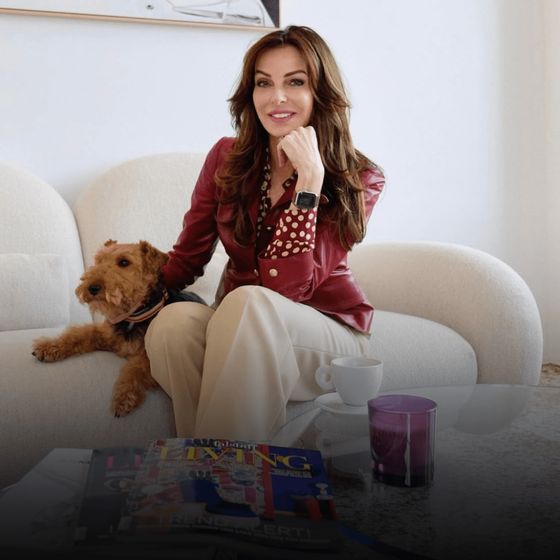
Angelika Rosam studied journalism and political science and joined the News publishing house through Austria's first in-house journalism training programme, spending six or seven years covering culture and film there. She later founded a corporate publishing agency and a beauty and lifestyle magazine. Around 2007 she and her husband joined Falstaff, which at the time was purely a wine and gourmet magazine. Twelve years ago this gave rise to Falstaff Living, which today appears nine times a year. In conversation with Alena Gröfler, she explains why a magazine should act as a scout, why Austria's designers need a stage and how she lives herself.
HOMEISSUE You studied journalism and spent years at the News publishing house. How did you end up in the world of interiors?
Angelika Rosam Goodness, it's a long way from News to the world of interiors. I studied journalism and political science, and one of my journalism professors was Alfred Worm. He was one of the best journalists, not only at News but in Austria generally. He started a journalism training programme at News, actually the first time this had been done at a publishing house in Austria, and brought around 25 to 30 students from his seminar on board and assigned them to different sections. I ended up with Heinz Sichrovsky in the culture section. At the time I thought: oh my goodness. Today I'm very glad of it. Essentially, everything I can do as a journalist I learned from him.
At News, she was, as she puts it, "a whirlwind Hollywood reporter". She was at Cannes for the film festival, at the Oscars, at the Berlinale or in Hollywood itself, and had direct contact with great Hollywood stars. "I felt like I was in a candy store." Then she met her husband, left News and became pregnant with their first son. She started a still-life column in the Presse's Schaufenster supplement, which allowed her to be a young mother without giving up her profession. "Because that's not me, and it wouldn't have worked." After eighteen months she went independent.
A SCOUT IN THE JUNGLE OF IDEAS
Your readers spend around ninety minutes on average with an issue. How do you create such strong reader loyalty?
We are flooded with so much information and so many ideas every day that we simply want to be a scout for our readers, a scout in this great jungle of ideas. We want to take our readers by the hand and tell them, across all our areas, what's in, what's on trend, what you'd better not do and where you need to go. All our magazines begin on a Friday evening, after a stressful week, when you pick up the magazine, sit down with a glass of wine and start reading. Falstaff is a special-interest product, a coffee-table product. You don't just throw it away, you put it aside and pick it up again when you want to know something.
She firmly believes in the future of print. "The print magazine will never die out," she says. At the same time, the online side is growing month by month, the team publishes between three and five articles a day, and the newsletter, which comes out every Saturday, now has 65,000 subscribers. She is quick to correct a common misconception. People always assume, she says, that a good journalist can do both print and online. "That's not right." An online journalist has to fit an enormous amount of information into a really short paragraph, and that is much harder than telling a story across two pages.
TALENT AND TRENDS
What contribution do the Designer Awards make to the design scene?
With the awards, what mattered most to me was that the Austrian design scene is very underrepresented. I wanted to bring Austrian designers out into the spotlight, give them more presence, create an event around it, invite the scene and show what Austria has to offer. Austrian designers are very reserved. They don't like to put themselves on public display or in front of the camera, which is completely different in Milan. That's why you have to give them a stage, so they can show how good and how innovative they are.
Angelika Rosam finds new talent at fairs in Copenhagen or in Milan, which for her is the most important fair of all, at press conferences and on social media. "And I love young designers who dare to do something, who are brave, who are different, who approach things unconventionally." At the same time, established names belong in the magazine too. Philippe Starck received the first lifetime achievement award at the Designer Awards.
WHAT MAKES GOOD DESIGN
Does the saying that luxury always sells hold true in times of crisis?
Yes, luxury is a lasting element. But only when it is genuinely high quality and long-lasting, in other words sustainable. Simply creating a luxurious product quickly, one that in the end isn't really so luxurious, doesn't work. Quality is luxury today. Brands that deliver quality endure, and they will weather any kind of crisis.
What is good design for you?
For me, good design is emotional. Good design has to completely captivate me. It has to move me emotionally. Good design also connects enormously, it connects people and communities. And it always sparks debate. People don't always agree, but there is discussion. It should also be functional. Personally, I have no use for a design piece I can't use in some way.
Her favourite piece at home is an old silver mirror she bought at auction. "People think it's a dust collector, but it isn't." This mirror is imperfect, since various pieces of silver have already fallen off. "But it's an old piece, and to me it is of extraordinary value." With a design piece, she says, you connect a past. "You connect memories, you connect a moment. Perhaps also a moment between people, a special relationship." For her, good pieces should give you an emotional home.
HOME
How do you live with your family, and what matters most to you at home?
In my magazine I have to cover every trend and style and can't focus only on my own taste. I'm actually more of a classic type. I also love traditions. I'm not the modern glass-façade woman. I think great modern architecture is wonderful, but I myself prefer to live in a more secluded way. I love my cosy corner. I like large doors that reach down to the floor, but I don't need glass surfaces through which people can watch me from outside. I have plants and flowers, because I need nature in my home, and I have my Minotti armchair, which stands in a corner. That's where I retreat when I don't want to know anything more about the outside world. That's my little Fort Knox, so to speak.
The family lives in a new building constructed in the Palladian style, a very classical style. At first glance you can't tell at all that it is new, and many people ask whether the house is old. Her favourite room is the library. It is fairly small but very cosy and traditionally designed, with a slightly English feel in its materials and fabrics. "I love retreating there, because it simply gives me the calm I need." On her coffee table stand three praline dishes by Lobmeyr in different sizes, which she keeps refilling with chocolates. "They're my bedtime treats, so to speak."
Asked where she would live if not in Vienna, she names Italy and Forte dei Marmi, but she loves the Napa Valley even more, although she is not as passionate a wine drinker as her husband. She loves it "because it's so unpretentious and so relaxed and just extremely easy-going". When she drove into the area, she felt at home there in a second. That feeling of being at home, she says, is extremely important when you are so far away.
The full conversation with Angelika Rosam is available on the HOMEISSUE Podcast with Alena Gröfler.