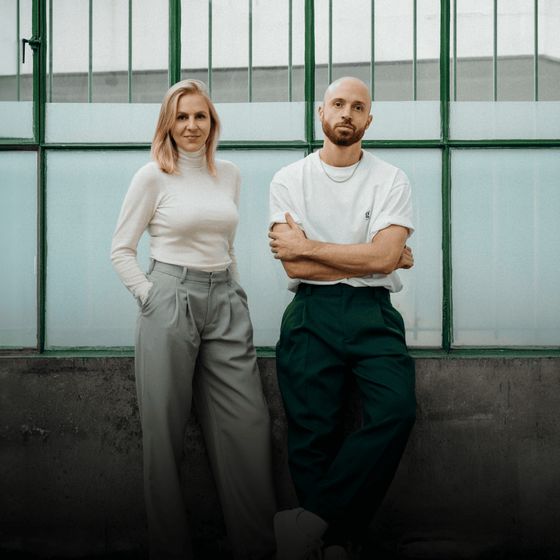
Johannes Budde and Meike Papenfuss have been a couple since 2017, both come from Cologne, and in 2020 they founded their design studio BUDDE together. Today the studio licenses its designs to companies in Denmark, the Netherlands, Italy, Spain and Germany, and creates collectibles that are sold through international design galleries. Since 2022 the two have exhibited at Milan Design Week every year, and in 2025 they are spending the entire first half of the year in the city. In conversation with Alena Gröfler, they explain why they did not become a furniture label of their own, where their ideas come from and how they live and work as a couple.
HOMEISSUE You founded your design studio in 2020. What was your path up to that point?
Johannes Budde I studied architecture and had actually always been interested in art. Architecture was a bit of the sensible choice. After my studies I worked for a few years as an architect and interior architect, but I could never fully identify with it. I increasingly felt like a project manager, and if I'm honest, it never really felt creative to me. For a short while I actually wasn't doing so well physically either, and I really noticed that I was doing something that simply wasn't good for me.
So Johannes Budde went back to working on his own projects. For a few weeks he even made art, and a very large charcoal drawing came out of it. Alongside this he designed furniture in 3D, which for him was "really almost just a hobby". Meike suggested entering the designs in a newcomer competition, and out of around 1,000 applicants he made the shortlist. Meike Papenfuss had always found starting a company exciting; she just lacked an idea of her own. She watched Johannes's projects from the outside and encouraged him to show them: "Hey, why don't you use your personal Insta account." To this day it is the studio's official account.
A NAIVE START
Looking back, 2020 was probably the right timing, the two say. It was the time of Covid, and people were taking an interest in their own four walls. "We really did go into it completely naively." They produced prototypes, posted them online and sold them directly, everything made in Germany. But the more orders came in, the more they found themselves dealing only with logistics. To scale it up they would have had to rent large warehouses, and that was not quite their dream. You always have to ask yourself what you really enjoy and what you are good at, they say. They saw their strength in design, and so instead of a label of their own they became a design studio that works in partnership with furniture companies.
How do you divide things up today?
Meike Papenfuss Roughly speaking, I look after the whole back office, finance and legal matters. Marketing and branding we discuss together, and in the end we make all decisions jointly. But the design itself always comes from Johannes, and I'm more of a sparring partner and add my two cents.
Johannes Budde I'm someone with a clear creative focus, but with that come weaknesses in running a business. If I had to do all of it on my own, it would be chaos.
CLARITY, NOT REDUCTION
You focus on the essential rather than the superfluous. How do you decide what is essential?
Johannes Budde and Meike Papenfuss It isn't necessarily about aesthetic reduction or minimalism; we are always looking for a certain clarity in a design. We always want a design to leave no more questions open. And especially no why questions. Why was this done like that? Why is this detail still here? We keep challenging ourselves with that question throughout the design process. It often means that a BUDDE design makes do with very simple basic forms and that we use just a single gesture to bring in a twist. That twist then often gives a design its character.
One example is the Cut Coffee Table. It consists of a steel plate from the middle of which three legs are laser-cut and bent downwards. This leaves the table with an opening that serves as a frame for changing contents. The two made a point of ensuring that vinyl records just fit inside, but it can also be filled with plants or with nothing at all. The table, they say, invites users "to put the final exclamation mark on it".
PLAYGROUND AND SERIES
What appeals to you about the collectibles, the exclusive pieces?
Johannes Budde and Meike Papenfuss Collectible design sits somewhere between art and the functional object. These are one-offs or limited editions, and there we work above all with innovative materials and production methods, almost without restrictions. These pieces help us build our reputation and our brand. The collectible is a bit like the playground.
How did the collaboration with Nando Studio come about?
Johannes Budde and Meike Papenfuss Nando Studio is also a Cologne studio and makes wonderful rugs. One impulse from our side was that at home we love sitting on the floor, on the soft rug. In our research we came across nomadic desert peoples, for whom rugs are the main pieces of furniture. The desert became a theme in general, hence the name Dune.
Dune, too, relies on a single gesture, something the two only noticed in hindsight: one cut, and part of the rug folds up into a lounger. They did not know beforehand how this new typology would be received. "Of course it's always a moment where you're vulnerable," they say.
HOME
At the moment Johannes Budde and Meike Papenfuss have two apartments. The one in Milan is rented furnished, and what they miss there is greenery, a forest or simply hearing a bird. It is precisely this switching that makes it more exciting for them, because coming back to Germany, you see everything with fresh eyes.
How do you live yourselves? What does your apartment in Cologne look like?
Johannes Budde and Meike Papenfuss We don't have a concept that we followed through rigorously; a living space goes through phases with you. As an observation I'd say we've become more colourful over the past few years, and I think our work has too. Change also comes from the prototypes, which stand quite prominently in the apartment. And we like moving the furniture around the whole apartment. Our living space isn't very big, but then you move the dining table to the other side of the room and the sofa somewhere else. You see your own home completely afresh when you're suddenly sitting on the sofa in the other corner.
Some of their favourite pieces are prototypes with a story. The Era lamp, which they now sell with an Italian company, was built entirely by Johannes Budde himself at the start, and they still use it every day. The large charcoal drawing from his weeks as an artist now hangs on the wall too. "It stands a little for the beginning," he says, "without that having been planned at the time."
Johannes Budde is in charge of the lighting. A fixture by Occhio provides dimmed light in the evening. "I'm definitely not the ceiling-spotlight type." Meike Papenfuss would love an open loft. But because they are a couple in private life and work together, it is super important to be able to close a door now and then, so that each of them can have time alone.
How strictly can you separate partnership and work at all?
Johannes Budde and Meike Papenfuss There isn't even any taking it home, because everything is somehow one. But we have the impression that this is actually good for the relationship, because it isn't just a job, it's our dream. It's like a shared baby. But it does help if you resolve every now and then: now it's just a date.
The full conversation with Johannes Budde and Meike Papenfuss is available on the HOMEISSUE Podcast with Alena Gröfler.