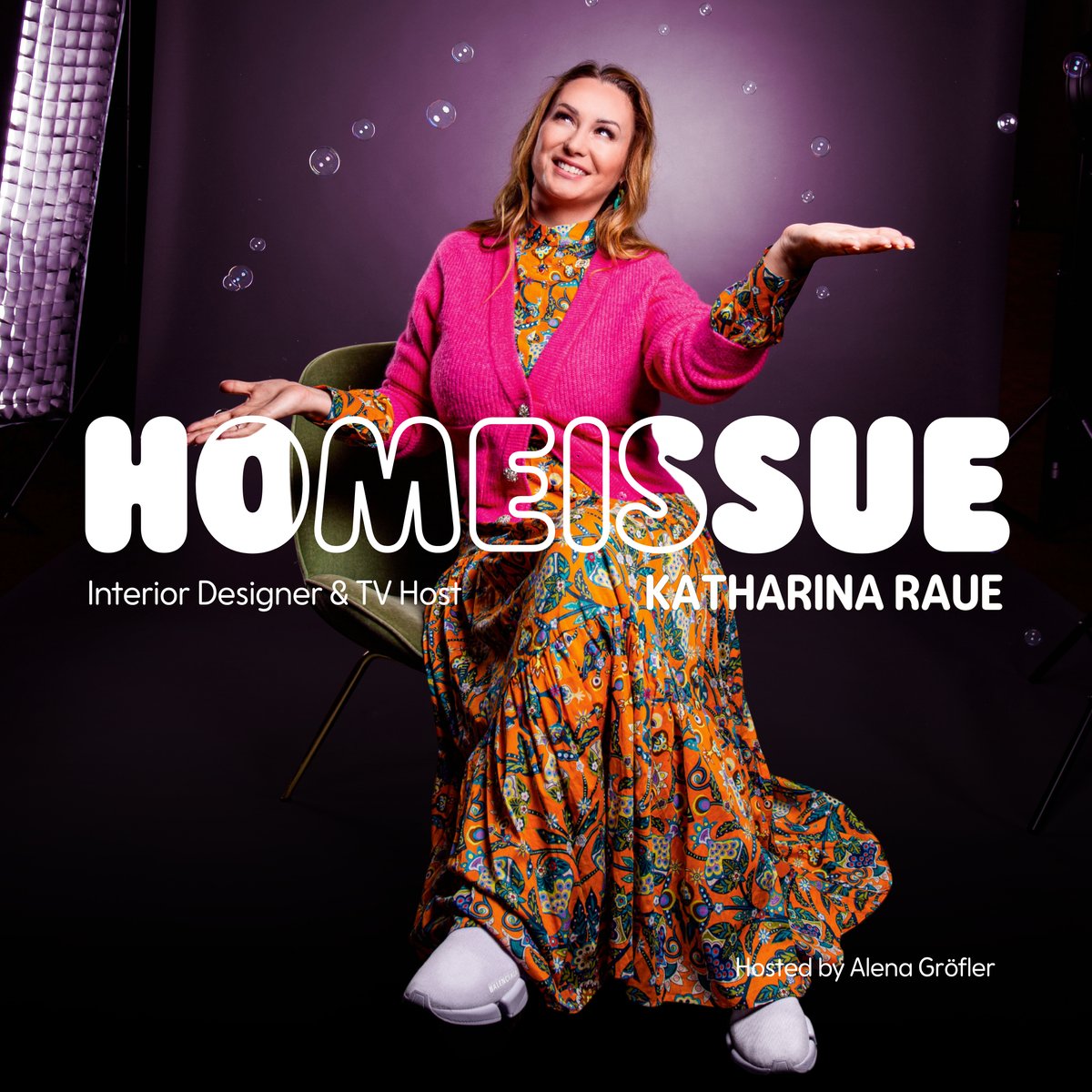
Katharina Raue comes from Graz and grew up in Upper Austria. She studied design and fine arts in London, then molecular microbiology and German studies, and spent ten years as editor-in-chief of the hospitality magazine Rolling Pin. In 2017 she moved to Berlin to join her husband, the chef Tim Raue. Today she designs interiors and brands and does the set design for food shoots. In conversation with Alena Gröfler, she explains why she would not hire herself, what she spends the money on when the budget is tight and why her studio is a cave of glitter.
HOMEISSUE Yesterday you sent me greetings from a food shoot where you are doing the set design. How does something like that work?
Katharina Raue Thanks to my past I have a very large collection of props, which I can still put to good use today. That's actually very practical. And with a husband who is a chef and does a lot of collaborations and cookbooks, I often get the chance to use it.
Because she sat her school-leaving exams a year early, she decided to take a year for herself and went to London at 17 to study. Because the course was very expensive, she switched to molecular microbiology. She found the subject really exciting and the people boring. So she devoted herself to her third love, German studies. By chance, the girlfriend of the then editor-in-chief of Rolling Pin was in the same class, and the magazine happened to be looking for someone. On the phone she was asked: "Do you like eating, do you like drinking, do you like travelling?" She said yes and was, as she puts it, "young, willing and cheap."
Shortly after she started, the global financial crisis hit. Of seven staff, only she and her editor-in-chief were left after two months. For six months the two of them brought out the magazine every three weeks, plus a second, quarterly magazine, and they designed and hosted all the events. "It really was the best school you could have." After a year or two she was editor-in-chief.
And you held that post for ten years, didn't you?
I did, for ten years. It actually brought together everything I had studied. From molecular microbiology came the structure and transformation of food. On top of that I was allowed to help design the magazine, and of course there was German studies for the writing. They were really thrilling, long years.
FROM THE PAGE TO THE ROOM
How did you then make the step from magazines to interior design?
I don't think the step is that big at all. One is two-dimensional and the other is three-dimensional. We were already married and were still in a long-distance relationship. Back then, in 2017, there was no way to say I'll keep doing my job when I'm not on site. I moved to Berlin and thought, it'll be fine. And so I more or less slid into self-employment, even though I didn't want to at all.
"I wouldn't hire myself either," she says, because with so many travel days it simply would not work. She came to interior design because she had always enjoyed it and was convinced she was good at it. Slowly but surely she began to change things at Restaurant Tim Raue, always in consultation. First it was a child's bedroom for friends or family, then the restaurant's toilets, then came the television programme with her husband, in which she redesigned restaurants. Since then she has designed entire restaurants.
THE EARRINGS ARE THE NAPKINS
Can interior design and fashion be separated at all?
I don't think you can separate them, because both are an expression of personality. When I furnish a restaurant, I always say: of course the hardware has to be in place. You need the tables, you need the chairs, all of that has to work. But you can't stop there. It would be just like a woman putting on only trousers and a jumper and then not wearing any earrings. The earrings are the napkins. The cool glasses would be the beautiful glass or the coaster. It is exactly these small details that bring an interior to life. And even if the person looking doesn't notice it, you immediately feel much more comfortable without really knowing why.
That is why, before she designs for someone, she also, to be honest, looks at what they are wearing. "Because normally people wear what they feel comfortable in." Her husband calls her own style individual; she would call it eclectic. "In that sense I don't have a style. I have a personal touch." If you know your proportions, she says, you can wear whatever you like. "The same goes for rooms, by the way."
BEAUTIFUL DESIGN AND GOOD DESIGN
In your view, what makes good design in a restaurant?
Good design means that people don't notice they are sitting in good design. They have to sit down and think: I'd like to have that at home too. I'm a big fan of architecture magazines, where you see these beautiful holiday homes. In the photos they always look sensational, but I would never want to live there. It's all so cold, so minimally furnished. If I don't dare put my feet up on the sofa, it's beautiful design, but it isn't good design. It can be beautiful, it can be aesthetically sublime and have won thousands of awards. But it's not for me.
For the television programme she received photos and measurements from a research team four weeks before filming began, and after that she had one week for the concept. The budget for the entire room was "around about 5,000 euros."
Do such limited resources restrict your creativity?
With a bigger budget I can put in a signature piece that looks really fabulous. That's difficult when you have little money. In the starred restaurant we were at, for example, I said to the owner: I have to put a lot of money into conjuring up the lighting that a starred restaurant simply needs. I had to have 13 new light outlets drilled. But you'll have to replace your chairs within a year, they don't have the quality to survive in a restaurant. It was more important to me to create islands of light, so that people sit at their table and believe they are more or less alone and don't notice they have neighbours. You simply think more about what matters to you, what your priority is, and then you follow it.
HOME
What makes a home a place with a high quality of life?
It may sound very simple, but for me the centre of the house is my sofa. I moved in with my husband in Berlin, and he had a designer sofa. It was beautiful, pale blue, a dream. I might sit on it bolt upright for half an hour, but a sofa is something you have to be able to sink into. We have since replaced it, and I have an enormous sofa in emerald velvet with a thousand cushions. Designing a home means having an extension of your personality. I come home, and there has to be a place where I think: this is me. It's like a perfect relationship. In a perfect relationship you shouldn't have to pretend. And that's how your perfect home has to be. You have to walk in and think: this is me.
When Alena Gröfler asks how you find a balance when your partner lives in a more pared-back way and you yourself are more of a maximalist, Katharina Raue replies: "Are you describing the relationship between me and my husband perfectly right now?" The two of them have agreed that the base colour in the apartment should be very calming. Her husband is strongly stimulated by smells and visual stimuli and needs things calmer so that his mind can rest, and she does not want to take that away from him. The pictures, the rugs and the large furniture are therefore kept in a more subdued colour palette. "But in return my studio has exploded." It is "a cave of glitter, colour and more is more," with pictures in a thousand colours above her sofa, slogans and a neon sign on the wall. "I love it when things just shout at me," she says.
The full conversation with Katharina Raue is available on the HOMEISSUE Podcast with Alena Gröfler.