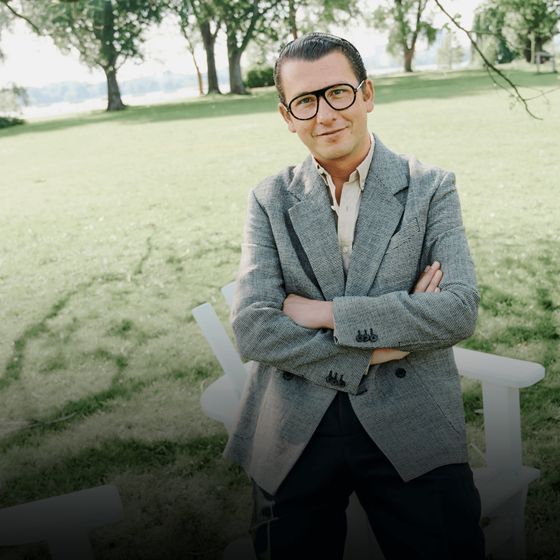
Fabian Freytag was born into a family of architects and studied at the Berlin University of the Arts. On his first day there, he met the fellow student with whom he went on to found his first company straight away. Straight after graduating, he began building up the Oberhafenkantine Berlin, an event venue he has run for 15 years. Today his studio of eight people in total works on private homes as well as hospitality projects, such as the restaurant Moritz in St. Moritz. In conversation with Alena Gröfler, he talks about joie de vivre in design, money, artificial intelligence and how he lives himself.
HOMEISSUE You were born into a family of architects. When did you know it would be interior design for you?
Fabian Freytag It actually happened organically, because we started developing interior architecture projects straight away at university. On the first day, out in the corridor, I met a fellow student, and I founded my first company with him straight away. Our first assignment was to draw the junk in the corridor, because all the years before us had left their junk there. He sat on the floor and wrote on it: finest designer garbage. And I thought: that's a cool guy, so let's do something.
His first commission came about at the University of the Arts, too. One day someone came into the studio who wanted to put up notices because he was looking for interior architects. "Yes, we're interior architects, we're definitely applying," the two of them said. Then they followed him and took down every notice again. They were the only ones who applied, and they landed their first commission, the conversion of an apartment at Hackescher Markt. That reference led straight to a second project, which led to a third, and by the end of their studies they had a portfolio.
JOIE DE VIVRE AS A STANCE
Your book "Gently Radical" is about places such as Venice, Saint-Tropez and Bad Gastein. Which eras and places inspire you most?
It's mostly places that had some glorious moment. Venice at its best, for example, a truly rich city that was strategically well positioned. And of course that always culminates in design. The same goes for the seventies, when the economic miracle came after the Second World War and with the moon landing we had taken a step where, suddenly, for a moment, everything was right. Of course we had the Cold War, but there was this optimism. That did a lot for design and led to a free-spiritedness. And that inspires me, because in times like these it matters all the more.
Fabian Freytag dislikes the panel discussions about resource scarcity and about how we will have to get used to living in fewer square metres. The answer to this era, he says, can hardly be that we are no longer allowed any joie de vivre. If resources have to be saved, to him that means the furniture giants have to stop making furniture and we look instead at which table from the classifieds we put in our homes. "But I think that in furniture design we should keep up the fight a little longer and insist on joie de vivre."
NO KICKBACKS
With private clients, every project begins with conversation. Anyone who suggests simply sending the floor plans online first gets a clear answer: "You have to talk." He cannot take on someone else's life, he says, but he can take on the feeling of how a home should feel. He can "slip it on like a camouflage suit". That's why he doesn't commit to a style, and for him new projects always need a new solution, partly out of respect for the person paying. "I don't recycle ideas."
What makes you most creative: an unlimited budget or scarce resources?
Money matters insofar as it has to be there, because it doesn't work with nothing at all. But our financing model is different, because we take no kickbacks. I don't care what a project costs in the end, and I mean that in both directions. Because we don't earn on products and genuinely only make money from our own work, there are certain jobs we can't do, which I'm completely fine with. It's important to me that we're transparent and that I don't take away from myself or my team the chance to think in every direction. An ordinary shop can't buy something from the classifieds, because there's no margin on it.
He explains his stance through his background. He did not grow up rich or poor, he says, but in a healthy middle class, where you got up in the morning, did your work and earned your money for it. Cashing in of any kind is "not my cup of tea at all". "I want to be able to sleep well at night, and that's why budgets are so secondary for me."
THE LAMP FROM THE AI
How has artificial intelligence changed your design process?
Before AI, like everyone else, we worked a lot with collages. When I started writing the book, I said to myself, I have to make 200 collages just to define a goal. What is the style, what do you even like, which colour combination? That was exactly when artificial intelligence knocked on the door. I fed the collages into the AI, and that gave rise to a way of working that we started in the team.
He works mostly with Midjourney, and he sees the downside clearly. "The original aesthetic of AI is already dead," he says. Anyone who doesn't refine the results further will soon end up with something too standardised. For his Milano Lamp, he reversed the usual process. Normally you define a design and factor in every parameter from your own knowledge, and the more you know, the more it paralyses you. AI, by contrast, gives no thought to feasibility. When a lamp emerged from his back-and-forth with the machine, he asked himself a simple question: "If I find something that cool, why don't I just build it?" Making it real took the team to a glassworks in Scandinavia and to a stone quarry. When the lamp was exhibited in Germany, the grandson of Osvaldo Borsani came by and said it looked like a lamp his grandfather could have developed. "And he immediately bought two for his study."
His advice to young designers is to take their own work seriously and have it photographed by a photographer who specialises in interiors. At the start of a career, he says, everyone makes the same mistake: you want to please, and you should stop. "You mustn't be ashamed of your own opinion." It keeps getting easier, you just have to practise. "It's a service profession, but it's also a profession that asks for your opinion."
HOME
How do you live yourself? Does your home look like your projects?
It's exactly the way I'd do it anywhere else. I would have furnished the apartment that way for someone else, too. My penthouse is an extension built on top of the coach house where the studio is, and it had an inhuman number of drawbacks, small windows, for example. It's 90 square metres, and you have to fit three rooms, a proper kitchen and a bathroom into that. I lived in it for two years and worked out which routines were good, and then, with just a few interventions, I managed to turn it around so that the rooms work. I hated the bedroom, it really was such a tiny thing, and colour made it good.
Storage matters a great deal to him, and it has to be designed, not just hidden in a cupboard, because you live with it. Then there are vintage pieces he has found and a sofa he has had for years and had reupholstered. He makes no distinction at all between this approach and his work. "I'm not the minimalist at home," he says, who sits on a bench and thinks everything should look like nothing. In theory anyone can say, go bold and do a bit too much, but you need people who actually do it. "That's why I see it as the task you have, to be the living example."
What gives a room a high quality of life?
You have to arrange the perspectives and the places where you sit so that they make beautiful pictures. That comes from set design: what does the camera see? That doesn't remotely mean everything has to be crammed full. I don't mean it in that twee sense. But it needs a certain opulence, and it has to be furnished like a film set. That's why plans always lie. I don't stand in every corner of a room. I enter a room, I sit in a corner, I have a dining table, and from there I have a perspective. It's always worth placing yourself in these different perspectives, and then you see at once what's missing.
The full conversation with Fabian Freytag is available on the HOMEISSUE Podcast with Alena Gröfler.