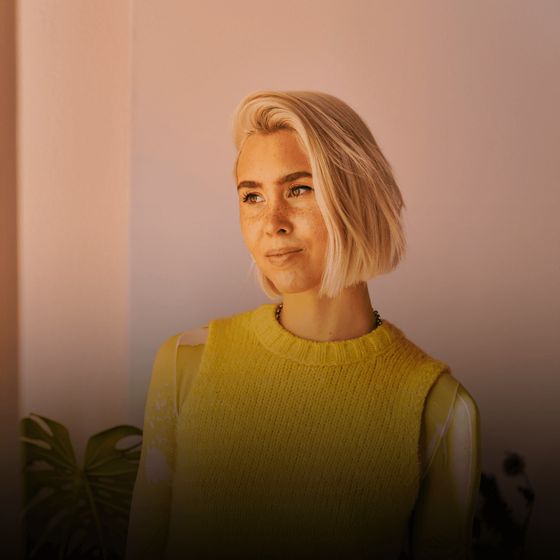
In early 2021 Sarah Hartmann moved into her first Berlin apartment of her own, 20 square metres in Moabit. She studied communication design with a focus on editorial design and at the time had a full-time creative job. With a photo of her desk she began to show her interiors on Instagram. According to Alena Gröfler, around 366,000 people now follow her. In the second half of 2024 she launched House of Heart, a modular shelving system made of bent sheet metal that she had previously worked on in secret for more than two years. In conversation with Alena Gröfler, she explains why she could never live in a minimalist home, what role Wes Anderson plays in her colours and why she now shoots her product photos on her phone.
HOMEISSUE I read a story about your desk. Was that the kick-off that set everything in motion?
Sarah Hartmann The infamous desk. That's really the origin story. It was early 2021, so peak Covid winter, when I moved into my first Berlin apartment of my own, 20 square metres in Moabit. My Instagram account was a public profile, but only friends, family and people who really knew me followed me, I had no more than 400 followers. And suddenly I posted a desk. I really did get a few messages saying things like: Why are you posting your desk now? Where are you going with this?
All she really wanted was to show her creative projects and her concept for the apartment. "I never in my life expected that I would one day be able to make a living as an influencer," says Sarah Hartmann.
A MOODBOARD TO LIVE IN
When people follow you, they get the feeling that you are constantly changing your apartment. Does that happen one project after another or all at once?
A lot happens at the same time. The projects take weeks, and it would simply be too boring for me to have so much waiting time until things arrive or dry. I'd rather start the next project. With my apartment, I created my own moodboard. I couldn't bear the dark, wet, sad Berlin Covid winter. I wanted to create a dopamine home that makes me wake up full of happiness and stimulates me anew every day. That's why I could never live in a very minimalist apartment, even though I find that very beautiful in other people's homes.
Why the seventies, of all decades?
I think I came to the seventies through Wes Anderson. He's my icon when it comes to colour inspiration. His colour worlds are very much inspired by the seventies, lots of orange, brown and cognac tones with mint. What really gets me is the language of form and design that was hugely on trend in the seventies and is actually a design classic today: the rounded, organic shapes and materials like fibreglass. And one of my goals is to turn my living space into a playground for my inner child.
THE SHELF NOBODY COULD MAKE
You founded your own label in 2024. How did that come about?
That was four months ago. But behind the scenes I had already been working on it for more than two years, completely in secret, without anyone apart from my closest circle knowing.
It all began with an upcycling video in which Sarah Hartmann turned a shoe rack from the classifieds into a rack for glasses. The video was made two summers ago and, to her complete surprise, went through the roof. It also reached Stefanie Giesinger, who invited her to her new, still empty apartment. On the interior design team's first plans, her shelf was already drawn in, from floor to ceiling, for the dressing room. At home she discovered that it wasn't possible, because the original is a vintage piece that is no longer produced. For months she looked for a manufacturer who could bend sheet metal that way. She found none in Berlin, none in Germany and none anywhere in Europe. The collaboration with Stefanie Giesinger didn't happen.
Even so, she didn't let go of the shelf. It was no longer about the apartment. She wanted to prove to herself that she could make it happen. "I just really want to hang it in my own living room." Then two friends from her home town, both metalworkers, wrote to say they could help her. Over two years the three of them developed a machine that bends the metal exactly the way she wants. The upcycling project became a modular system whose parts hook into one another, and she founded her brand on it.
Which colour is the bestseller?
The bestseller is still raw aluminium, that silver look, which develops a certain patina over time. Very close behind is bright orange, which I named Tangerine. To this day I haven't managed to release a colour that didn't sell out within 24 hours.
A ONE-WOMAN SHOW
Do you have a team by now, or do you still produce everything yourself by hand?
Everything House of Heart has ever released goes through me. Production, planning, logistics, customer service, visits to producers, social media posts, I do it all. It really is a one-woman show, and I wouldn't recommend it, because I got help too late. And I only have 24 hours too, I only have two hands, and I have to eat something now and then. Now I've pulled the emergency brake and told myself: I need help.
From January a friend will help her. "Get help when you need help," she advises anyone planning something similar. Above all she wants to hand over logistics, and she also wants to share the building work, after having blisters on every single one of her fingers. She will keep driving to the powder coater in Brandenburg herself, though. She wants to get to know the people she works with personally.
Another lesson concerns photography. At the start she absolutely wanted perfectly clean product photos and renderings, like everyone else, and put a great deal of money into them. "In the end, nobody cares about that." A floating shelf without context doesn't do anything for her either. "It doesn't belong in a photo studio, it belongs in a living space." Today she shows the shelves in real living spaces. "I really shoot them on my phone, from the hip."
At her pop-ups she hardly had to explain the product to anyone, and some people travelled from other cities just to buy a shelf. "I cried every evening because it overwhelmed me so much, in a good way."
What would you advise young designers or aspiring entrepreneurs?
Well, I don't want to say anything wrong, because I still don't know what I'm doing here. I think it's also a big lesson to know that nobody really knows what they're doing. Somehow that gives you a certain security too. Get help when you need help. And getting a tax adviser is rule number one, so that you can concentrate on being creative. I'm not just incredibly bad with numbers, I hate them too.
HOME
What does home mean to you?
I think it's exactly that: I'm building a playground for my inner child. What I always wanted, a Villa Villekulla. Pippi Longstocking is my icon anyway. Even if it's only a period apartment in Berlin, it's my little villa, where I can go wild however I like. For many people, home is probably a way of withdrawing and finding calm. I live more actively in the sense that I constantly get inspiration from my living space. Of course withdrawing is part of it too, but above all it's about letting things flow, being creative and collecting inspiration.
Asked about trends, she describes a shift away from the Ikea principle of "one trip, everything in", towards a home made of individual pieces collected over time and chosen more thoughtfully. Ideally they are one-offs, vintage finds or bargains from the classifieds that you are particularly pleased about because you searched for them for a long time. That brings the most joy, she says, and it is a sustainable way of furnishing. Chrome remains her highlight.
Her own apartment keeps changing too. She is currently replanning the entire apartment, including when it comes to colour drenching. "So next year there'll be a lot, a lot, a lot of painting again. I'm really looking forward to it."
The full conversation with Sarah Hartmann is available on the HOMEISSUE Podcast with Alena Gröfler.