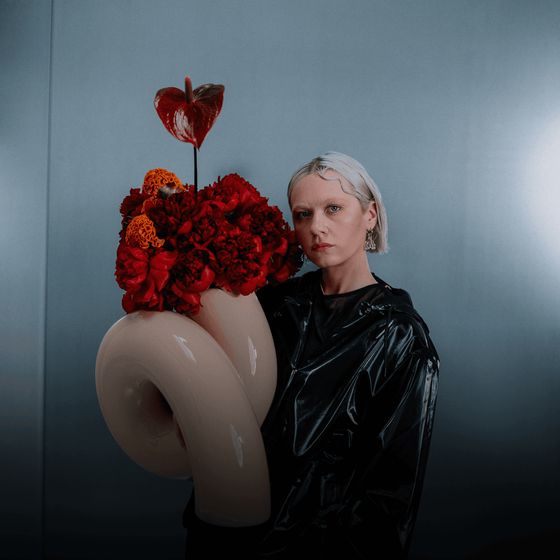
Ju Schnee paints mainly in oil and links her paintings to augmented reality, alongside sculptures. Her collaboration partners include Porsche, USM Haller and Motel a Miio. In summer 2024 she had her major solo exhibition with the gallery Better Go South in Berlin, where she lived for a long time. Today she lives with her husband in Vienna, and at the time of the conversation, in early January 2025, her solo exhibition is on show there. In conversation with Alena Gröfler, she explains how she found her visual language, why she won't let herself be put in a box and what home means to her.
HOMEISSUE You said in an interview that one of the best tips you ever received was "Find your USP". How did you find yours?
Ju Schnee It doesn't happen overnight. I've always listened a lot to my intuition and done a lot of things because I enjoyed them, and not because I had to or to earn a lot of money. I didn't go straight into studying art; there were a few detours. First I trained as a yoga teacher and taught yoga, and after that I came back to my roots, which had always been creative. I often asked myself whether the years before had been wasted. At some point I decided: nothing is wasted. The experiences you have are now a huge benefit to me in my art.
Ju Schnee found her visual language, as she puts it, "without really searching and comparing myself". She listened to her inner self and observed herself: "what do I do when nobody's watching me, what do I draw on a sheet of paper when nobody's watching me". The answer was squiggles. Committing to them took courage. She thought every third person would say: "I can draw those squiggles too". At some point she dared to say: "okay, this is my art now."
PAINTINGS THAT MOVE
We share a passion for dancing. How much has dance influenced your art?
Through dance I was already fascinated by movement as a child, by how my body feels, combined with music. For me it's extremely important that my paintings move, because the idea for a painting already comes from an intuitive physical movement. That's where these organic, soft, round curves come from. Simply freezing the movement on a canvas that hangs more or less dead on the wall was never enough for me. I always needed that activation, to bring the painting back to life, because it is alive.
The fact that Ju Schnee links her art with digital elements is not received positively by all traditional galleries at first, "because it's simply hard to put it in a box". Even so, she deliberately tries not to let herself be pushed into a box, even if it makes things harder with some partners. If you stand behind your work one hundred percent, you will find the right people in the long run, she believes. She doesn't want to meet artificial intelligence with raised fists either, but positively and playfully: "I don't know you yet, let's get to know each other, do you want to be my friend".
KNOCKING ON DOORS
You approached Motel a Miio yourself, and a collaboration came out of it. Is being proactive a tip for young artists?
It has always worked well for me. My experience is that in the classical art world it isn't very smart to approach galleries. There you create and wait until the right people come to you. But I've always been on the other side. If I sit here at home, nobody is going to knock on the door and say: we've been waiting for you. At the beginning, when nobody knows you yet, it definitely makes sense to knock on doors on your own initiative. Of course a few will say no or not answer at all, but then you're still where you were before.
With Motel a Miio, it all began with tableware. Ju Schnee was setting up a new studio in Berlin and asked Motel a Miio whether they would send her some tableware. In return she offered her work, "for whatever". About six months later Motel a Miio opened a store in Nuremberg and asked whether she would like to paint it. While she was painting there, she spoke with the owner in person for the first time, and both thought it would be great to make a product together. The first prototype of the vase, which is still on sale today, needed hardly any changes.
When someone buys your art for their home, what feeling should it bring to the space?
I'm always happy when my art does something to people emotionally. When they see the painting and say: I can't tell you what it is, it completely draws me in, it makes me think. That is the most important thing of all for me. The sculptures are one-offs and therefore very high-priced. With the vases I want to reach people who say: I don't have 6,000 euros for a sculpture, but I'd like to have this shape at home, because it gives me joy whenever I put fresh flowers in it.
Ju Schnee's advice to young artists is to dare, not to look left and right and not to compare themselves with others. The more personal and genuine you are, the more success you will have, "because nobody is like you".
HOME
What do living and home mean to you personally? How do you live?
Rather minimalist, partly because I live with my husband and we have to make sure our two tastes go together. But we're both big fans of minimalism. Because I see my works every day in the studio, they don't hang in my home as well. At the moment one painting of mine hangs in our place, but if it sells, then it simply won't hang there any more. There are lots of neutral tones, lots of wood, light white walls. But it mustn't be too cool and sterile; I want to come home and feel one hundred percent at ease.
In every corner of her apartment there is a small diffuser with essential oils, and she loves burning incense. "My mum always says, wow, it smells like a health food shop," Ju Schnee says. Whoever comes in smells citrus and a little bit of incense smoke. She herself hardly notices the scent any more. But when she has been away on holiday for a while, she can already smell it in the stairwell. "And I think that's just my smell of home." Light is also extremely important to her. There isn't a single ceiling light in her apartment, only the bare bulb still hanging there. Instead there is a floor or table lamp in every corner, and she controls many of the bulbs by app to adjust the lighting mood, depending on how she is feeling.
Do you keep work and home completely separate?
At the moment I mainly do the paintings in the studio, and everything that's digital, taxes and paperwork, I mostly do at home. My studio isn't far away, a five-minute walk, but it's still separate. In future we'd like to combine the two more. My husband is a director and a really creative mind, and we would love an open space where you can paint, create and make things while also being in your living space, really a live-work studio.
Whether the next apartment will be in Vienna or Berlin, she doesn't quite know herself. In summer 2024 Ju Schnee spent three months in Berlin for her exhibition and had actually made up her mind to move back. Then came autumn in Vienna, where her family and friends are close by. "There's much less FOMO than in Berlin, which is also totally wholesome." Even so, she believes it will stay Vienna, and for work projects she wants to be in Berlin more often and for longer. "The base is now in Vienna, and that's fine too."
The full conversation with Ju Schnee is available on the HOMEISSUE Podcast with Alena Gröfler.